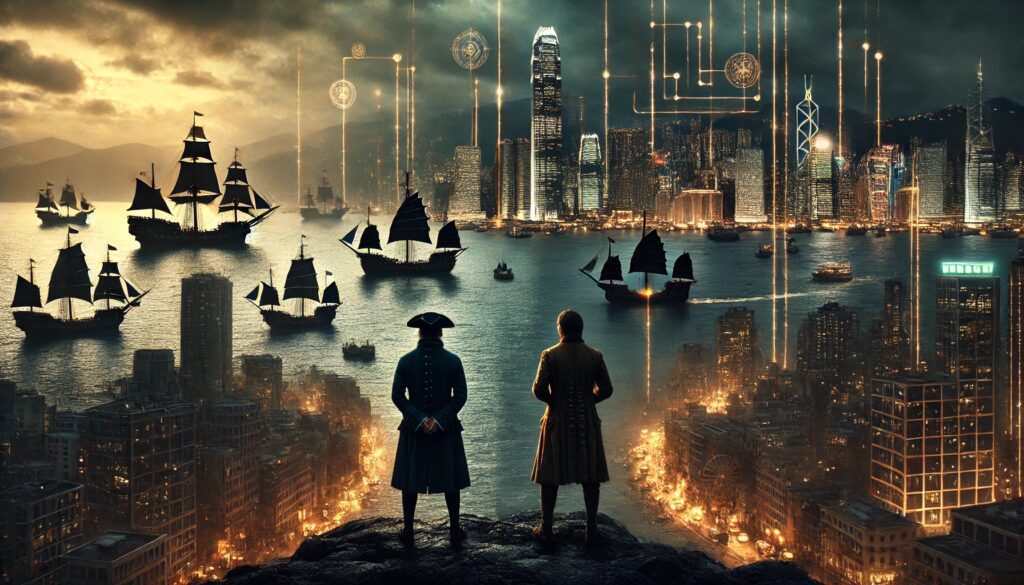
Every empire starts with hunger.
Some want land.
Some want power.
A few just want control.
Jardine Matheson wanted all.
They began as outlaws.
Became merchants.
And evolved into a machine that rewired Asia itself.
While kings fell and countries burned, Jardines kept stacking.
Two centuries later, their fingerprints are still on:
- Hong Kong’s skyline
- Its money
- And its mind.
This isn’t just a story about business.
It’s a story about dominance through evolution.
And if you read between the lines, you’ll see the blueprint every power player still uses today.
ORIGINS OF AN EMPIRE
Early 1800s.
The British Empire is expanding.
China is the richest market on Earth – but closed to foreign traders.
Enter William Jardine.
A Scottish doctor who realized there’s more money in commerce than in curing fevers.
He teams up with James Matheson, another sharp Scot who sees the game clearly:
The future belongs to whoever controls the trade routes.
In 1832, they form Jardine, Matheson & Co.
Their product mix?
- Tea.
- Silk.
- Cotton.
- And something far more addictive – opium.
The margins were insane.
The risk was higher.
But the rewards were generational.
They built a network across India and China.
- Ships.
- Brokers.
- Smugglers.
A private empire operating in the shadows of the East India Company.
When the Chinese government cracked down, Jardine didn’t fold.
He went to London – and used his influence to incentivize Britain into war.
That war became the First Opium War (1839–1842).
Britain won.
China lost.
And in the aftermath, Hong Kong was born.
Who moved in first?
Jardine Matheson.
THE STRATEGIC LAND GRAB
The ink wasn’t dry on the Treaty of Nanking before Jardines claimed the best land on the island.
They set up their headquarters overlooking the harbor – the perfect vantage point for global trade.
From there, they built everything.
-
Shipping fleets that moved goods faster than navies.
-
Warehouses that fed every port city in Asia.
-
Insurance and banking systems that kept profits flowing.
They didn’t wait for infrastructure.
They became the infrastructure.
While other traders fought over prices, Jardines owned the docks.
They controlled the flow.
They made the rules.
That’s Rule #1 of empire building:
Never compete when you can control.
They didn’t sell products.
They sold permission.
THE AGE OF CONSOLIDATION
As Hong Kong grew, Jardines grew with it.
They weren’t a trading house anymore – they were a power grid.
Their reach extended everywhere:
- Property
- Shipping
- Banking
- Construction
- Insurance
- And transport.
They were in every deal that mattered.
Every street that moved.
Every hand that got paid.
When other companies rose, Jardines invested.
When markets crashed, Jardines bought the ashes.
They turned volatility into opportunity – again and again.
When the Japanese invaded Hong Kong in 1941, Jardines’ offices were seized.
When the Communists took China in 1949, Jardines lost everything on the mainland.
But they didn’t die.
- They regrouped.
- They rebuilt.
- They waited.
That’s Rule #2:
Retreat isn’t defeat – it’s reload.
They tightened operations in Hong Kong.
They doubled down on real estate, shipping, and international trade.
By the time others recovered, Jardines was already running the next cycle.
THE KESWICK DYNASTY
Power always passes through blood.
And for Jardines, that bloodline was the Keswick family.
Descendants of William Jardine’s sister, they became the stewards of the empire.
Five generations deep.
They didn’t just inherit wealth – they inherited strategy.
Every Keswick was raised to think in decades, not quarters.
They didn’t chase trends.
They built frameworks.
That’s how Jardines survived:
- Wars.
- Regime changes.
- Global depressions.
- The fall of British rule.
Each generation evolved the machine but never broke the rhythm.
That’s Rule #3:
Protect the core – adapt the shell.
When the world changed, Jardines didn’t panic.
- They restructured.
- They diversified.
- They found leverage where others saw chaos.
FROM MERCHANTS TO MASTERS
By the mid-1900s, Jardines had morphed into a full-scale conglomerate.
They built and acquired empire-level companies:
-
Hongkong Land – the titan of property development.
-
Dairy Farm – retail and supermarkets across Asia.
-
Mandarin Oriental – a symbol of luxury worldwide.
-
Jardine Motors – distribution of top car brands.
-
Cycle & Carriage – their foothold in Southeast Asia.
-
JEC (Jardine Engineering) – building the cities themselves.
- Real estate powered retail.
- Retail drove logistics.
- Logistics reinforced finance.
A perfect loop.
That’s Rule #4:
Create systems that feed themselves.
The result?
Cash flow became infinite.
No single loss could take them down.
They built redundancies into their empire the way nature builds them into DNA.
If one market fell, another rose.
If one product failed, another scaled.
That’s how you build anti-fragile power.
THE INVISIBLE HAND
By the 1970s, Jardines didn’t need to flex.
They were everywhere already.
Their new HQ – Jardine House – became the first skyscraper in Hong Kong.
Those circular windows became a symbol of control.
Every hole was a “porthole” – a reminder of their maritime roots.
They didn’t shout success.
They designed it into the skyline.
Even after 1997, when Hong Kong returned to China, Jardines stayed one move ahead.
They shifted incorporation to Bermuda – just in case politics went sideways.
They diversified deeper into Asia.
They kept one foot in the West, one in the East, and both hands on the cash flow.
That’s Rule #5:
Always keep your escape routes open.
While competitors obsessed over public image, Jardines mastered the art of quiet dominance.
They were the ghost in the machine – pulling levers no one else could see.
LESSONS FROM THE EMPIRE THAT REFUSED TO DIE
Jardine Matheson is more than a company.
It’s a living case study in strategic immortality.
Here’s what you can learn from the empire that still owns half of Hong Kong’s heartbeat:
1. Use leverage, not labor.
They didn’t get rich by working harder – they built systems that worked for them.
2. Position is power.
They didn’t wait for opportunity.
They bought the land opportunity would pass through.
3. Control distribution.
If you control the flow of goods, you control everyone who needs them.
4. Move through chaos.
They turned wars and regime changes into pivots.
Every collapse became a chance to expand.
5. Build for centuries.
Trends die.
Systems endure.
Jardines thought in lifetimes, not fiscal years.
6. Stay decentralized.
No single product or region could kill them.
That’s how they survived 200 years of volatility.
7. Reputation compounds.
Once you’re seen as inevitable, deals come to you.
Jardines didn’t chase – they attracted.
8. Blend shadow with spotlight.
They didn’t need fame.
Power moves better in silence.
THE LEGACY OF POWER
Today, Jardines still runs through the DNA of modern Asia.
- Their companies own prime land in Central.
- Their hotels shape luxury tourism worldwide.
- Their retail chains feed millions daily.
You may not see their name often.
But every time you:
- Step into a 7-Eleven in Hong Kong
- Drive a Mercedes in Singapore
- Or stay at a Mandarin Oriental
you’re inside their system.
That’s real power.
Not hype.
Not followers.
Infrastructure.
Jardines didn’t just make money.
They built the foundation other people make money on.
THE FINAL LESSON
If you strip their story down to its essence, Jardines did what every master player eventually learns to do:
They stopped reacting to the world – and started shaping it.
- They turned risk into leverage.
- They turned time into compound interest.
- They turned chaos into legacy.
Two Scots landed in China with a handful of ships.
Two centuries later, their descendants still control empires across the Pacific.
That’s what happens when vision meets structure.
When patience meets ruthlessness.
When evolution beats emotion.
They didn’t just survive history.
They wrote it.
The empire never ended.
It just changed form.
And that’s the real secret of Jardines.
When you understand power as a system, not a moment…
You never run out of moves.
Jardines mastered leverage before the word existed – building systems that printed cash for centuries.
The same laws of power, positioning, and cash flow still run today.
If you’re ready to stop reacting to money and start engineering it…
Then it’s time to Unlock Your Money Mind – the blueprint that shows you how.
Start building your empire today.
You May Also Like:
Exclusive Multi-Millionaire Success Stories: Plastics Kingpin
This Guy Looks Homeless - But He Owns the Whole Block
The Art of Stacking the Odds in Life, Business, and Power
Famous Playboys: Life Lessons From Hugh Hefner
Robert DeNiro: Profitable and Timeless Communication Principles
The Art Of Business: How Andy Warhol Became One Of The Richest Artists In The World
How to Gain Unshakable Conviction in Contrarian Plays
Lessons from the Greatest Business Minds in History: Insights for Success

My name is Mister Infinite. I've written 701+ articles for people who want more out of life. Within this website you will find the motivation and action steps to live a better lifestyle.
