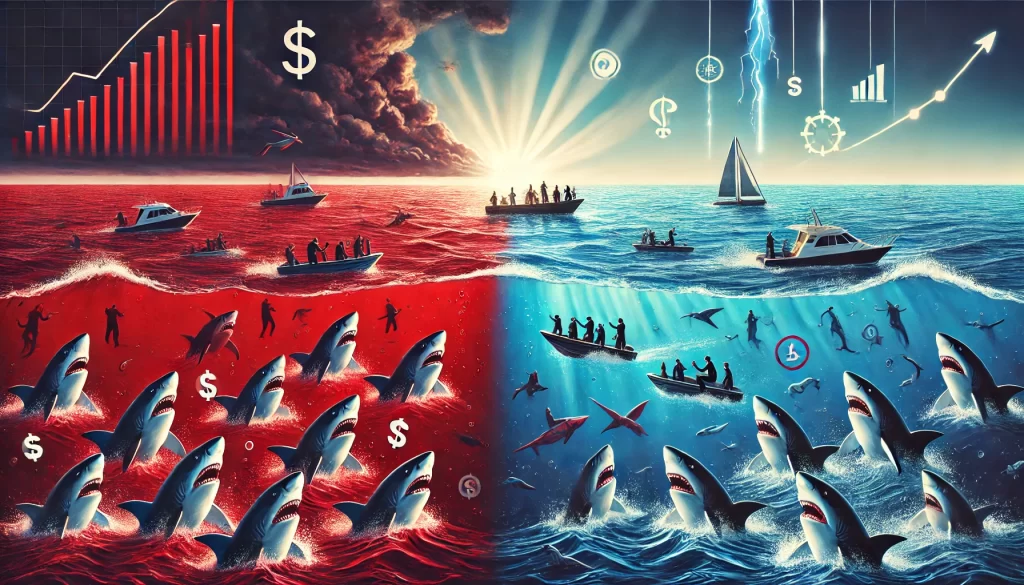
Most people think a Blue Ocean market is an empty territory.
- No noise.
- No competition.
- No pressure.
They imagine planting a flag where no one else is standing.
That’s not a Blue Ocean.
That’s a desert.
Real Blue Oceans don’t exist in a vacuum outside demand.
They exist inside it.
They aren’t found by moving away from people.
They’re created by changing the Mechanism of the result and the Narrative of the problem.
- Same buyers.
- Same desire.
- Same surface outcome.
Different cause.
That difference is everything.
The Core Misunderstanding
The original Blue Ocean concept was about value innovation.
But most people watered it down into a bad heuristic:
“If there’s competition, it’s too late.”
That belief quietly kills more businesses than failure ever does.
Sameness is.
When everyone agrees on why something works, the only remaining levers are:
-
Price
-
Speed
-
Volume
-
Features
That’s how Red Oceans are formed.
Blue Oceans are created when you break agreement on causality.
1. The Death of “Better”
In a saturated market, “better” is a death sentence.
- “Our flights are better.”
- “Our circus is better.”
- “Our software is more consistent.”
All of those statements accept the industry’s default explanation of reality.
You’re agreeing on:
-
What the problem is
-
How it should be solved
-
What success looks like
Then you try to turn the same crank harder.
That’s not innovation.
That’s exhaustion.
When you compete on “better,” you’re trapped in the Red Ocean Mechanism.
You fight on incremental gains.
- Margins compress.
- Customers comparison-shop.
- Price becomes the deciding factor.
This isn’t because customers are cheap.
It’s because nothing meaningful changed.
2. The Unique Mechanism: The Real Innovation Engine
Real innovation is not a feature.
It’s a mechanical shift in how results are produced.
A Unique Mechanism answers one question clearly:
Why does this work when other things failed?
- Not what it does.
- Not what steps it uses.
- Not what tools it includes.
Why it succeeds.
When that answer changes, the market reorganizes around it.
The Airline Example
Southwest Airlines didn’t innovate “cheapness.”
They changed the Operational Mechanism.
The airline industry ran on a Hub-and-Spoke model:
-
Large airports
-
Complex routing
-
Delays
-
Baggage transfers
-
High overhead
Southwest flipped the mechanism to Point-to-Point:
-
Fewer airports
-
Faster turnaround
-
Standardized fleet
-
No transfers
Low prices were not a promise.
They were an inevitable byproduct of the mechanism.
That’s a Blue Ocean move.
Not louder marketing.
Not better branding.
A different engine.
The Circus Example
Cirque du Soleil did not innovate “clowning.”
They changed the Creative Mechanism.
Traditional circuses competed on:
-
Animal acts
-
Star performers
-
Bigger spectacles
Cirque removed animals entirely.
They fused:
-
Acrobatic performance
-
Music
-
Theater
This was not a better circus.
It was a different category wearing the same skin.
Same demand.
Different cause.
3. The Narrative: The Value Multiplier
If the Mechanism is the engine, the Narrative is the fuel.
Most “value” in a Blue Ocean is delivered through interpretation, not function.
The Narrative performs a Belief Flip.
It tells the customer:
“Here’s a new way of looking at things.”
That message creates relief.
Relief lowers resistance.
Resistance dropping creates authority.
Authority removes price pressure.
How Narrative Repositions the Buyer
Southwest doesn’t sell cheap flights.
They sell escape.
“You aren’t a budget traveler.
You’re someone avoiding the bureaucracy of the hubs.”
Cirque doesn’t sell circus tickets.
They sell cultural status.
“You are not watching tricks.
You are attending high art.”
The product doesn’t change alone.
The identity of the buyer changes.
That is why price becomes secondary.
4. Why “No Competition” Is a Trap
Competition is proof of life.
It means:
-
The problem is painful
-
The buyer is aware
-
Money is already flowing
Those are advantages, not obstacles.
“No competition” usually means:
-
No urgency
-
No education
-
No budget
A Blue Ocean move doesn’t run from competition.
It invalidates it.
When you introduce a new Mechanism plus a new Narrative, you’re no longer “better” than competitors.
You’re incomparable.
You’re playing a different game entirely.
Same Outcome, Different Cause
One seller says:
“Eat fewer calories.”
Another says:
“Fix hormonal signaling.”
Both promise fat loss.
The buyer doesn’t compare prices.
Why?
Because the cause of the problem has now been re-framed.
Once causality changes, comparison collapses.
5. The Moat of Inconvenience
Real Blue Oceans are taken quietly.
Not because they’re hidden.
But because competitors can’t follow without destroying themselves.
To copy Southwest, an airline would need to:
-
Sell its fleet
-
Abandon hubs
-
Fire staff
-
Rewrite operations
-
Admit the old model was wrong
To copy Cirque, a circus would need to:
-
Fire animal trainers
-
Abandon tradition
-
Hire artists
-
Rebuild identity
The moat is not branding.
The moat is the structural and psychological cost of change.
Competitors are trapped by:
-
Their sunk costs
-
Their public positioning
-
Their ego
-
Their existing audience
That is why Blue Oceans stay blue.
6. Saturation Is a Symptom, Not the Disease
Markets feel saturated when explanations stagnate.
When everyone agrees on:
-
The problem
-
The solution
-
The process
The market tunes out.
Introduce a better explanation and saturation disappears instantly.
You aren’t louder.
You’re clearer.
And clarity beats volume every time.
7. How Real Markets Are Actually Taken
Markets aren’t taken by fighting harder.
They’re taken by redefining the game.
The sequence is simple:
-
Identify the default mechanism
-
Break it cleanly
-
Install a new cause
-
Frame the old way as obsolete
Once the explanation changes, the market follows.
Not because you convinced them.
Because it finally makes sense.
The Bottom Line
A Blue Ocean is not a place with no competition.
It’s a place with no comparability.
- You don’t escape demand.
- You don’t avoid money.
- You don’t invent desire.
You:
-
Own the demand
-
Change the mechanism
-
Control the narrative
When you own the explanation of the problem, you own the market for the solution.
Everything else is noise.
If This Clicked, You’re Ready for the Next Layer
Most people read ideas like this and nod.
Then they go back to competing on effort.
Unlock Your Money Mind is for people who want to actually apply this thinking to income.
- Not by chasing trends.
- Not by copying models.
- Not by “being better.”
But by learning how to:
-
Identify leverage-friendly markets with real demand
-
Build offers around a clear, defensible mechanism
-
Escape price pressure by controlling explanation, not volume
-
Design income systems that work without constant presence
This isn’t about guarantees or shortcuts.
It’s about understanding how money actually flows to value, and positioning yourself where that flow already exists.
If you’re done fighting crowded games and ready to build something that makes sense structurally, start here.
Learn the frameworks behind leverage, positioning, and scalable income systems.
Everything else is noise.
You May Also Like:
Top 6 Reasons Why No One Wants To Buy From You
How To Create Compelling Content That People Actually Care About
Mastering Branding: A Comprehensive Guide
5 Steps To Making A Better Website
Unlock Massive Revenue Growth: Why You Need a Platinum-Priced Offering in Your Product Lineup
Content Chronicles: Unlocking the Mysteries of Effective Storytelling
What Everybody Ought To Know - About Making A Swipe File
The Hidden Stacks Behind Success: Why Skills Alone Aren’t Enough

My name is Mister Infinite. I've written 701+ articles for people who want more out of life. Within this website you will find the motivation and action steps to live a better lifestyle.
