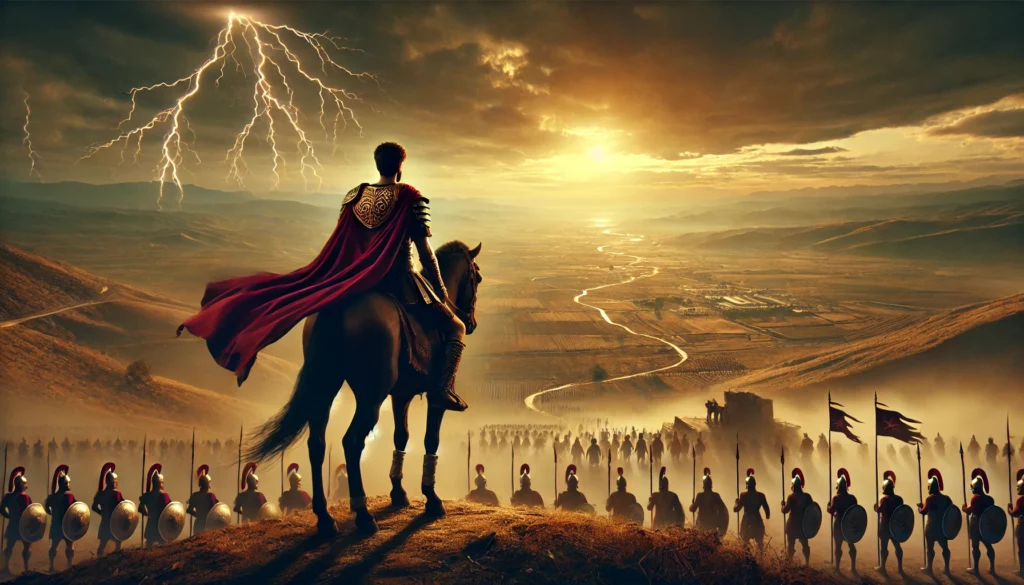
Alexander the Great was one of the most successful and influential people who ever lived.
And he did it young.
- By age 20, he became king.
- By age 22, he had invaded the Persian Empire.
- By age 25, he had shattered the most powerful empire on earth.
- By age 30, he controlled territory stretching from Greece to India.
- Then he died at 32.
Read that again.
Most people at 32 are still saying:
“I’m figuring things out.”
Alexander had already altered civilization FOREVER.
- Cities were named after him.
- Cultures fused because of him.
- Trade routes changed.
- Power structures changed.
- The spread of Greek language and ideas reshaped huge parts of the world for centuries.
Even after death, his influence kept expanding.
That alone should make you pay attention.
Because studying people like Alexander is not hero worship.
It’s pattern recognition.
History occasionally produces outliers.
People operating at such a level that you almost have to study them like a separate species.
You study them because they reveal leverage.
Because if someone repeatedly bends reality at a scale few others ever have…
you should probably ask:
“What did they understand that everyone else missed?”
We’re about to take a deeper look into that question.
And beneath the battles and conquest are lessons that still apply now.
Because human nature doesn’t change.
1. Great Minds Are Built Before They Are Seen
Before Alexander conquered the world, he spent years learning from Aristotle.
Not just military strategy.
- Philosophy.
- Politics.
- Science.
- Ethics.
- Logic.
- History.
- Rhetoric.
Imagine being personally taught by one of the greatest thinkers who ever lived.
Most kings were trained primarily for war.
Alexander was trained to think.
This gave him something many rulers lacked:
Mental models for understanding how the world works.
He wasn’t simply collecting information.
- He was learning how to reason.
- How to analyze.
- How to question assumptions.
- How to see second-order consequences.
This matters because people often look at extraordinary success and focus on visible outcomes.
- The battles.
- The victories.
- The empire.
But those outcomes usually sit on top of invisible foundations.
- Ideas.
- Education.
- Mentors.
- Beliefs.
- Frameworks.
Alexander’s military brilliance did not emerge in a vacuum.
Years before he crossed into Asia, Aristotle had already helped shape how he viewed:
- Leadership
- Culture
- Politics
- And knowledge itself.
You can see traces of this influence throughout his life.
Unlike many conquerors, Alexander wasn’t interested only in destroying civilizations.
He studied them.
Learned from them.
Absorbed elements of them.
- He collected scholars.
- Encouraged exploration.
- Founded cities that became centers of learning.
This curiosity was unusual for a military ruler.
It reflected a mind trained to seek understanding, not merely domination.
There’s a lesson here.
Most people spend years trying to improve results while ignoring the source of results:
The mind producing them.
Alexander inherited a kingdom from his father.
But he inherited a way of thinking from Aristotle.
And that intellectual foundation may have been just as valuable as any army he ever commanded.
2. Speed Creates Power
Most people think power comes from size.
- Bigger company.
- More money.
- More followers.
- More employees.
- More resources.
Alexander repeatedly proved something different.
Again and again he moved before enemies could fully organize.
- He crossed rivers before opponents expected movement.
- He attacked before plans stabilized.
- He refused to let larger systems settle into comfortable positions.
Why?
Because speed forces everyone else into reaction mode.
And reaction mode is weakness.
Think about your own life.
How many opportunities disappear because people spend months:
- Thinking
- Researching
- Waiting
- Asking
- Debating
- Hesitating
Meanwhile someone else moves.
Not perfectly.
Just faster.
The first mover often shapes reality.
People overestimate intelligence.
Alexander understood tempo.
And tempo became a weapon.
3. Momentum Is More Powerful Than Motivation
People obsess over motivation.
Alexander obsessed over momentum.
Big difference.
Motivation comes and goes.
Momentum compounds.
After victories Alexander often pushed forward instead of stopping.
Not because he was addicted to movement.
Because he understood psychology.
- Winning changes people.
- Confidence grows.
- Belief grows.
- Expectations change.
- Soldiers begin expecting success.
- Enemies begin expecting defeat.
That matters.
All battles begin psychologically before they become physical.
The same thing happens in business.
- One sale becomes three.
- Three become ten.
- Ten become social proof.
- Social proof creates trust.
- Trust creates growth.
- Momentum creates force multiplication.
But most people kill it.
They:
- Celebrate too long
- Disappear
- Overanalyze
- Wait for inspiration
- Start over
4. Lead From The Front
Alexander nearly died many times.
Not because he was careless.
Because he led from the front.
His men repeatedly saw him where danger was greatest.
Not behind the army.
Inside it.
People today love giving orders from safety.
Alexander understood something deeper:
People trust visible sacrifice.
(Skin in the game).
If you ask others to suffer while you remain comfortable…
belief collapses.
People follow behavior.
- Not speeches.
- Not slogans.
- Not mission statements.
People ask:
“Does he actually live this?”
Alexander’s men knew the answer.
Modern translation:
- Want your audience to trust you?
- Want employees to believe you?
- Want people to follow your lead?
Go first.
Move first.
Demonstrate first.
Leadership isn’t verbal.
Leadership is visible.
5. Morale Beats Numbers
Alexander routinely faced larger armies.
On paper that should have ended badly.
But paper misses psychology.
People are emotional creatures.
- Morale spreads.
- Fear spreads.
- Belief spreads.
- Narratives spread.
Alexander understood this.
His armies increasingly carried an aura.
An identity.
People began fighting with the belief:
“We don’t lose.”
Meanwhile enemies often entered battle thinking:
“We’re fighting Alexander.”
And half the war was already over.
You see this everywhere.
- Certain companies gain momentum.
- Certain creators gain momentum.
- Certain people walk into rooms with momentum.
Perception becomes force.
Most people ignore this because perception feels soft.
It isn’t.
It changes behavior.
Behavior changes outcomes.
Outcomes become reality.
6. Adaptability Beats Fixed Systems
Alexander adjusted constantly.
- Terrain changed.
- Conditions changed.
- Opponents changed.
So tactics changed too.
At Issus he reinforced weaknesses and shifted positioning rather than forcing a rigid system.
Many people become emotionally attached to process.
Alexander became attached to results.
Huge difference.
Weak thinking says:
“This is how we do things.”
Strong thinking asks:
“What works?”
Not stubbornness.
This applies to:
- Business models
- Content
- Offers
- Relationships
- Fitness
- Money
- Identity itself
Some people defend systems that stopped working years ago.
Alexander would have adjusted.
7. Boring Infrastructure Creates Big Outcomes
History remembers battles.
Alexander focused on systems.
- Supply routes.
- Governors.
- Roads.
- Cities.
- Administration.
This matters.
People love visible outputs.
Nobody gets excited about infrastructure.
But infrastructure quietly determines outcomes.
Think about modern examples:
- Your email list.
- Your audience.
- Your systems.
- Your habits.
- Your environment.
- Your sleep.
- Your connections.
These things are easy to overlook.
Until you realize they create almost everything.
People obsess over tactics.
They ignore structure.
Structure wins.
8. Success Creates New Problems
Power doesn’t remove problems.
It upgrades them.
As Alexander expanded, new enemies appeared:
- Ego
- Court politics
- Flatterers
- Status games
- Manipulation
Arrian repeatedly warns about one danger:
The courtier.
Translation:
Yes-men.
People who survive by managing perception rather than truth.
- Success creates distance.
- Distance creates blind spots.
- And blind spots destroy people.
Many people can survive struggle.
Success is harder.
Because struggle forces honesty.
Power often removes it.
9. Conquering Yourself Is Harder Than Conquering The World
This may be the deepest lesson in the entire story.
Alexander conquered nations.
But his greatest challenges increasingly became internal.
- Anger.
- Drinking.
- Impulse.
- Suspicion.
- Emotional volatility.
When he killed Cleitus (one of his top officers) in a drunken quarrel, it was a major warning sign.
And this pattern repeats endlessly throughout history.
External growth magnifies internal weakness.
- Money does this.
- Status does this.
- Fame does this.
- Scale does this.
If you are insecure:
more status often amplifies it.
If you are unstable:
If you lack self-control:
more power amplifies it.
People think success changes people.
The truth is, it reveals them.
Alexander could conquer Persia.
Conquering Alexander proved harder.
10. Culture Beats Force
Alexander eventually shifted toward integration.
He increasingly tried building a partnership between Macedonians and Persians rather than simple domination.
This was radical.
Many around him hated it.
But Alexander understood something:
You can’t maintain systems forever through force alone.
- You need identity.
- You need culture.
- You need buy-in.
This applies everywhere.
- A business without culture breaks.
- A movement without culture collapses.
- A team without culture fragments.
Control scales poorly.
Culture scales better.
11. Reality Does Not Care About Ego
Many people become trapped by labels.
“I’m this kind of person.”
“I’m not like that.”
“This is who I am.”
Alexander repeatedly adjusted according to reality.
Reality came first.
Ego came second.
People today often reverse it.
They protect self-image over results.
Reality always wins eventually.
The world doesn’t care about personal narratives.
The world responds to behavior.
12. Courage Often Comes After Action
People wait for certainty.
Alexander often acted without it.
- No perfect information.
- No guaranteed outcomes.
- No complete map.
Movement came first.
Clarity followed.
Most people reverse the sequence.
They think:
“I’ll move once I feel ready.”
That moment often never arrives.
Action creates information.
Information creates clarity.
Clarity creates confidence.
Confidence comes after movement.
Not before.
The Real Alexander Code
People look at Alexander and see conquest.
But beneath the battles was a deeper operating system.
- Speed.
- Momentum.
- Belief.
- Adaptation.
- Visibility.
- Leadership.
- Psychology.
- Systems.
- Relentless action.
That combination is rare.
But there’s also a darker lesson.
Alexander achieved almost unimaginable external success.
Yet even he struggled with internal mastery.
That should tell you something.
Because if one of the most powerful men who ever lived still wrestled with:
- Ego
- Emotion
- And self-control…
then power itself isn’t the answer.
The external empire often grows faster than the internal one.
And eventually the gap shows up.
History remembers Alexander because he conquered much of the known world.
But the final opponent was not Persia.
- Not Darius.
- Not geography.
- Not war.
The final opponent slowly became:
Alexander himself.
And that lesson may be more valuable than every battle combined.
Want more mental models, frameworks, and ways of thinking that help you make better decisions?
Check out The Mental Model Playbook.
Inside you’ll discover powerful models drawn from:
- Business
- Psychology
- Strategy
- Investing
- And decision-making
that can help you:
- Spot opportunities faster
- Avoid costly mistakes
- And navigate life with greater clarity.
The better your models, the better your map.
And the better your map, the better your results.
You May Also Like:
Life and Business: A War of Attrition Where the Longest Time Horizon Wins
How Genghis Khan Built The Largest Land Empire In Human History
The East India Company: Lessons From A Colossus of Commerce and Empire
The Strategic Mastery Of Hannibal That Still Applies Today
Ethos, Pathos, Logos: The Rhetorical Triangle of Aristotle
The Hidden Pattern Behind Napoleon’s Impossible Rise
The Hidden Pattern Behind History’s Most Powerful Men
Why Taking Risks And Being Contrarian Isn't Enough: Here's What Really Makes You Win

My name is Mister Infinite. I've written 778+ articles for people who want more out of life. Within this website you will find the motivation and action steps to live a higher quality lifestyle.
