Most people think Henry Ford got rich because he built cars.
That’s not what happened.
Cars were already being built before Ford arrived.
The real breakthrough wasn’t the product.
It was the system.
Ford saw something most people overlook:
The structure behind the result matters more than the result itself.
This lesson applies far beyond cars.
It applies to:
- Business.
- Money.
- Health.
- Content.
- Relationships.
- Power.
And understanding it can completely change how you see the world.
Table of Contents
ToggleMost People Focus On The Visible Thing
People look at outcomes.
They see:
- Wealth
- Success
- Status
- Influence
- Growth
But they rarely look beneath the surface.
- They see the fruit. Not the tree.
- They see the building. Not the foundation.
- They see the result. Not the system producing the result.
This is where Ford thought differently.
Instead of asking:
“How do we build better cars?”
He asked:
“How do we build a better system for building cars?”
That single shift changed everything.
Before Ford, Cars Were Slow And Expensive
Before Ford’s production breakthroughs, cars were closer to handcrafted products.
- Teams of workers would move around a stationary vehicle.
- Each worker would perform different tasks.
- Parts were fitted manually.
- Processes varied.
- Production was slow.
- Costs were high.
The result?
Cars remained luxury items.
Only a small percentage of people could afford them.
Most manufacturers accepted this reality.
Ford didn’t.
He believed cars could become accessible to ordinary people.
To make that happen, he needed a completely different production model.
The Insight That Changed Everything
Ford studied factories.
He studied industrial processes.
He studied systems.
Then he noticed something.
Workers spent enormous amounts of time moving.
- Walking.
- Searching.
- Waiting.
- Transporting materials.
- Switching tasks.
A surprising amount of labor wasn’t actually creating value.
It was simply movement.
So Ford asked a simple question:
What if the product moved instead of the workers?
That question sounds obvious today.
At the time, it was revolutionary.
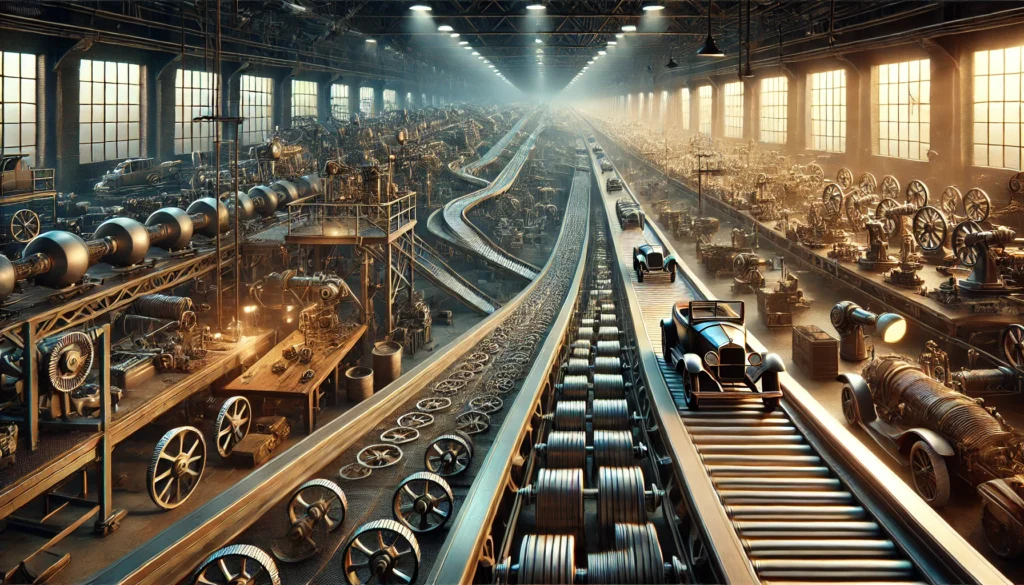
The Birth Of The Moving Assembly Line
Instead of workers moving to the car…
The car moved to the workers.
Each worker performed one specific task.
The vehicle advanced.
The next worker performed the next task.
Then the next.
Everything became organized around flow.
Not effort.
The results were astonishing.
- Production times collapsed.
- Costs dropped.
- Output exploded.
The same labor produced dramatically more vehicles.
And because costs fell, Ford could lower prices.
- As prices dropped, more people bought cars.
- As demand increased, production expanded.
- As production expanded, costs fell even further.
A powerful feedback loop emerged.
This wasn’t just manufacturing.
This was leverage.
The Real Innovation Wasn’t The Assembly Line
Many people think Ford invented the assembly line.
He didn’t.
Versions of assembly lines existed before him.
The real innovation was integrating multiple ideas into a complete system.
Ford combined:
- Standardization
- Workflow design
- Specialized labor
- Process optimization
- Supply chains
- Production sequencing
Into a machine that could scale.
This is an important lesson.
Breakthroughs often come from combining existing ideas in a better way.
People search for magic.
Often the answer is integration.
Why Systems Beat Effort
Most people try to solve problems with more effort.
- Work harder.
- Push harder.
- Stay up later.
- Do more.
Sometimes that works.
But systems almost always beat effort.
Imagine two people.
- The first carries buckets of water all day.
- The second builds a pipeline.
At first, the bucket carrier appears productive.
- They’re moving constantly.
- They’re busy.
- They’re sweating.
But over time, the pipeline wins.
- The pipeline works while the builder sleeps.
- The pipeline scales.
- The pipeline compounds.
Ford understood this.
He wasn’t trying to get workers to work harder.
He was redesigning the structure around the workers.
The structure created the outcome.
This Principle Is Everywhere
The same pattern exists in nearly every area of life.
- Business is a system.
- Marketing is a system.
- Sales is a system.
- Wealth is a system.
- Relationships are systems.
- Even your own psychology operates through systems.
Most people focus on isolated actions.
High performers focus on infrastructure.
For example:
- Many people want more money. Few people build systems that consistently create money.
- Many people want more opportunities. Few people build systems that attract opportunities.
- Many people want better health. Few people build systems that make healthy behavior automatic.
The visible result gets attention.
The invisible structure creates it.
The Hidden Cost Of Friction
Ford became obsessed with eliminating friction.
- Every unnecessary movement mattered.
- Every delay mattered.
- Every bottleneck mattered.
Small inefficiencies repeated thousands of times become massive inefficiencies.
This is true for your own life.
How much energy leaks through:
- Poor habits?
- Disorganization?
- Bad environments?
- Constant distractions?
- Weak processes?
- Unclear priorities?
Many people try to increase effort when the real answer is reducing friction.
The easiest way to improve output is often removing what slows output down.
Position Matters More Than Most People Realize
One of the deepest lessons from Ford is that position often matters more than effort.
Think about it.
A worker inside the system creates value.
The owner of the system captures value from the entire operation.
Both matter.
But they occupy different positions.
This principle shows up everywhere.
- A creator with distribution is positioned differently than a creator without distribution.
- An investor with capital is positioned differently than someone without capital.
- A business with systems is positioned differently than a business dependent on one person.
Many people ask:
“How can I work harder?”
A better question is:
“How can I improve my position to capture more value?”
Small changes in position often create larger outcomes than massive increases in effort.
Build The Machine
The biggest lesson from Henry Ford isn’t about cars.
It’s about building machines.
- Systems.
- Structures.
- Pipelines.
- Processes.
- Infrastructure.
The people who win consistently aren’t always the smartest.
They aren’t always the most talented.
They build better systems.
- A weak system forces constant effort. A strong system creates momentum.
- A weak system leaks energy. A strong system compounds it.
- A weak system creates friction. A strong system creates flow.
Most people spend their lives operating inside systems built by others.
The real leverage appears when you begin building your own.
That’s the lesson Ford understood.
And it’s the same lesson that still separates those who create outcomes from those who merely react to them.
The visible result gets the attention.
The invisible structure gets the reward.
Henry Ford didn’t become wealthy because he worked harder than everyone else.
He became wealthy because he built systems that produced more results from the same effort.
Most people spend their lives trying to work harder.
A smaller group learns leverage.
An even smaller group learns how to build systems.
That’s where real freedom begins.
If you want to understand the principles behind:
- Wealth creation
- Leverage
- Positioning
- And scalable income
check out Unlock Your Money Mind.
Inside, you’ll discover the:
- Mental models
- Business principles
- And hidden leverage points
that allow ordinary effort to produce extraordinary results.
Because the goal isn’t to work harder forever.
The goal is to build systems that work for you.
Learn more about Unlock Your Money Mind here.
You May Also Like:
The Le Corbusier Principle: How Changing Constraints Unlocks Limitless Creation
The Art of Stacking the Odds in Life, Business, and Power
Unlock the Genius Secrets of Leonardo Da Vinci: 9 Hacks To Boost Creativity
How Alexander The Great Conquered The World By 32 - 12 Lessons In Power, Leadership, And Momentum
The Strategic Mastery Of Hannibal That Still Applies Today
Unlock Breakthrough Success: How First Principles Thinking Can Rewire Your Mind for Innovation and W...
The East India Company: Lessons From A Colossus of Commerce and Empire
How to Spot Breakthroughs Before Anyone Else Does: The Hidden Law of Discordant Notes

My name is Mister Infinite. I've written 778+ articles for people who want more out of life. Within this website you will find the motivation and action steps to live a higher quality lifestyle.
- Mister Infinite
- Mister Infinite
- Mister Infinite
- Mister Infinite
- Mister Infinite
- Mister Infinite
- Mister Infinite
- Mister Infinite
- Mister Infinite
- Mister Infinite
- Mister Infinite
- Mister Infinite
- Mister Infinite
- Mister Infinite
- Mister Infinite
- Mister Infinite
- Mister Infinite
- Mister Infinite
- Mister Infinite
- Mister Infinite
- Mister Infinite
- Mister Infinite
- Mister Infinite
- Mister Infinite
- Mister Infinite
- Mister Infinite
- Mister Infinite
- Mister Infinite
- Mister Infinite
- Mister Infinite
- Mister Infinite
- Mister Infinite
- Mister Infinite
- Mister Infinite
- Mister Infinite
- Mister Infinite
- Mister Infinite
- Mister Infinite
- Mister Infinite
- Mister Infinite
- Mister Infinite
- Mister Infinite
- Mister Infinite
- Mister Infinite
- Mister Infinite
- Mister Infinite
- Mister Infinite
- Mister Infinite
- Mister Infinite
- Mister Infinite
- Mister Infinite
- Mister Infinite
- Mister Infinite
- Mister Infinite
- Mister Infinite
- Mister Infinite
- Mister Infinite
- Mister Infinite
- Mister Infinite
- Mister Infinite
- Mister Infinite
- Mister Infinite
- Mister Infinite
- Mister Infinite
- Mister Infinite
- Mister Infinite
- Mister Infinite
- Mister Infinite
- Mister Infinite
- Mister Infinite
- Mister Infinite
- Mister Infinite
- Mister Infinite
- Mister Infinite
- Mister Infinite
- Mister Infinite
- Mister Infinite
- Mister Infinite
- Mister Infinite
- Mister Infinite
- Mister Infinite
- Mister Infinite
- Mister Infinite
- Mister Infinite
- Mister Infinite
- Mister Infinite
- Mister Infinite
- Mister Infinite
- Mister Infinite
- Mister Infinite
- Mister Infinite
- Mister Infinite
- Mister Infinite
- Mister Infinite
- Mister Infinite
- Mister Infinite
- Mister Infinite
- Mister Infinite
- Mister Infinite
- Mister Infinite
- Mister Infinite
- Mister Infinite
- Mister Infinite
- Mister Infinite
- Mister Infinite
- Mister Infinite
- Mister Infinite
- Mister Infinite
- Mister Infinite
- Mister Infinite
- Mister Infinite
- Mister Infinite
- Mister Infinite
- Mister Infinite
- Mister Infinite
- Mister Infinite
- Mister Infinite
- Mister Infinite
- Mister Infinite
- Mister Infinite
- Mister Infinite
- Mister Infinite
- Mister Infinite
- Mister Infinite
- Mister Infinite
- Mister Infinite
- Mister Infinite
- Mister Infinite
- Mister Infinite
- Mister Infinite
- Mister Infinite
- Mister Infinite
- Mister Infinite
- Mister Infinite
- Mister Infinite
- Mister Infinite
- Mister Infinite
- Mister Infinite
- Mister Infinite
- Mister Infinite
- Mister Infinite
- Mister Infinite
- Mister Infinite
- Mister Infinite
- Mister Infinite
- Mister Infinite
- Mister Infinite
- Mister Infinite
- Mister Infinite
- Mister Infinite
- Mister Infinite
- Mister Infinite
- Mister Infinite
- Mister Infinite
- Mister Infinite
- Mister Infinite
- Mister Infinite
- Mister Infinite
- Mister Infinite
- Mister Infinite
- Mister Infinite
- Mister Infinite
- Mister Infinite
- Mister Infinite
- Mister Infinite
- Mister Infinite
- Mister Infinite
- Mister Infinite
- Mister Infinite
- Mister Infinite
- Mister Infinite
- Mister Infinite
- Mister Infinite
- Mister Infinite
- Mister Infinite
- Mister Infinite
- Mister Infinite
- Mister Infinite
- Mister Infinite
- Mister Infinite
- Mister Infinite
- Mister Infinite
- Mister Infinite
- Mister Infinite
- Mister Infinite
- Mister Infinite
- Mister Infinite
- Mister Infinite
- Mister Infinite
- Mister Infinite
- Mister Infinite
- Mister Infinite
- Mister Infinite
- Mister Infinite
- Mister Infinite
- Mister Infinite
- Mister Infinite
- Mister Infinite
- Mister Infinite
- Mister Infinite
- Mister Infinite
- Mister Infinite
- Mister Infinite
- Mister Infinite
- Mister Infinite
- Mister Infinite
- Mister Infinite
- Mister Infinite
- Mister Infinite
- Mister Infinite
- Mister Infinite
- Mister Infinite
- Mister Infinite
- Mister Infinite
- Mister Infinite
- Mister Infinite
- Mister Infinite
- Mister Infinite
- Mister Infinite
- Mister Infinite
- Mister Infinite
- Mister Infinite
- Mister Infinite
- Mister Infinite
- Mister Infinite
- Mister Infinite
- Mister Infinite
- Mister Infinite
- Mister Infinite
- Mister Infinite
- Mister Infinite
- Mister Infinite
- Mister Infinite
- Mister Infinite
- Mister Infinite
- Mister Infinite
- Mister Infinite
- Mister Infinite
- Mister Infinite
- Mister Infinite
- Mister Infinite
- Mister Infinite
- Mister Infinite
- Mister Infinite
- Mister Infinite
- Mister Infinite
- Mister Infinite
- Mister Infinite
- Mister Infinite
- Mister Infinite
- Mister Infinite
- Mister Infinite
- Mister Infinite
- Mister Infinite
- Mister Infinite
- Mister Infinite
- Mister Infinite
- Mister Infinite
- Mister Infinite
- Mister Infinite
- Mister Infinite
- Mister Infinite
- Mister Infinite
- Mister Infinite
- Mister Infinite
- Mister Infinite
- Mister Infinite
- Mister Infinite
- Mister Infinite
- Mister Infinite
- Mister Infinite
- Mister Infinite
- Mister Infinite
- Mister Infinite
- Mister Infinite
- Mister Infinite
- Mister Infinite
- Mister Infinite
- Mister Infinite
- Mister Infinite
- Mister Infinite
- Mister Infinite
- Mister Infinite
- Mister Infinite
- Mister Infinite
- Mister Infinite
- Mister Infinite
- Mister Infinite
- Mister Infinite
- Mister Infinite
- Mister Infinite
- Mister Infinite
- Mister Infinite
- Mister Infinite
- Mister Infinite
- Mister Infinite
- Mister Infinite
- Mister Infinite
- Mister Infinite
- Mister Infinite
- Mister Infinite
- Mister Infinite
- Mister Infinite
- Mister Infinite
- Mister Infinite
- Mister Infinite
- Mister Infinite
- Mister Infinite
- Mister Infinite
- Mister Infinite
- Mister Infinite
- Mister Infinite
- Mister Infinite
- Mister Infinite
- Mister Infinite
- Mister Infinite
- Mister Infinite
- Mister Infinite
- Mister Infinite
- Mister Infinite
- Mister Infinite
- Mister Infinite
- Mister Infinite
- Mister Infinite
- Mister Infinite
- Mister Infinite
- Mister Infinite
- Mister Infinite
- Mister Infinite
- Mister Infinite
- Mister Infinite
- Mister Infinite
- Mister Infinite
- Mister Infinite
- Mister Infinite
- Mister Infinite
- Mister Infinite
- Mister Infinite
- Mister Infinite
- Mister Infinite
- Mister Infinite
- Mister Infinite
- Mister Infinite
- Mister Infinite
- Mister Infinite
- Mister Infinite
- Mister Infinite
- Mister Infinite
- Mister Infinite
- Mister Infinite
- Mister Infinite
- Mister Infinite
