
Copywriting is the skill of using words to move people.
It’s not just “good writing.”
It’s not about sounding smart.
It’s about putting the right words in the right order so the reader keeps moving toward a choice.
Strong copy is built to:
- Grab attention
- Build interest
- Create desire
- And trigger action
Every line has a job.
If a line does not pull the reader forward, it’s slowing the sale down.
Below are nine basic rules that turn flat words into persuasive copy.
Table of Contents
Toggle1. Headline / Hook is 80% Of It
Nobody can buy from copy they never read.
That is why the headline is 80% of the work in copywriting.
Your headline is the gate.
If it fails, the rest of your copy may as well not exist.
You could write the greatest sales page in history.
But if the headline feels:
- Dull
- Vague
- Or weak
nobody will find out.
A strong headline should:
- Make a clear promise
- Point at a painful problem
- Spark curiosity
- Offer a useful result
- Or make the reader feel seen
The reader is always asking:
“Why should I care?”
Your headline must answer that question fast.
Don’t try to explain everything at once.
Give the reader one strong reason to stop, look, and keep reading.
2. The AIDA Formula: A Timeless Blueprint
AIDA stands for:
- Attention
- Interest
- Desire
- Action
It’s one of the oldest copywriting formulas because it follows the natural path of a decision.
People don’t jump from seeing an offer to buying it.
They move through stages.
- Attention: Stop the reader with a headline that breaks their normal pattern. If you can’t win attention, nothing else matters.
- Interest: Give them a reason to keep reading. Expand on the hook. Share a strange fact, sharp insight, useful detail, or story that matches or challenges how they see the world.
- Desire: Show them why the offer matters to their life. Don’t just list what it contains. Help them see how life could feel after the problem is solved.
- Action: Tell them exactly what to do next. Buy now. Join the list. Book the call. Click the link. Remove all doubt about the next move.
AIDA works because it does not rush the reader.
It earns the action one step at a time.
3. It’s About Subtext, Not Just Text
Your words say one thing.
Your subtext says what the reader should feel about it.
That hidden message often has more power than the words themselves.
Imagine two people offering the same product.
- One sounds calm, clear, and certain.
- The other sounds needy, loud, and desperate.
The offer may be the same.
The subtext is not.
Subtext speaks to the reader’s hidden:
- Feelings
- Fears
- Needs
- Status goals
- And core desires
It comes through your:
- Tone
- Word choice
- Rhythm
- Details
- And what you choose NOT to say
Weak copy says:
“Please believe me.”
Strong copy makes the reader think:
“This person clearly knows what they are doing.”
You don’t need to yell when the frame is strong.
The reader should feel the value before you directly explain it.
4. Create a Frictionless Reading Experience
Good copy should feel like a slide.
Once the reader starts, each line should pull them into the next one without bumps, confusion, or wasted effort.
- Short words help.
- Short sentences help.
- Clear ideas help.
Your copy should read at a fourth-grade level.
That does not mean the ideas must be childish.
It means the reader should not have to work hard or do emotional labor to understand them.
Deep ideas can still use simple words.
In fact, simple words often hit harder.
- Complicated words break the spell.
- Long blocks feel like work.
- Vague lines force the reader to stop and think.
Each pause creates a chance to leave.
Make the copy easy to scan.
Keep the rhythm moving.
Build momentum until taking action feels easier than clicking away.
5. Offer Incentives: The “Why”
The reader does not care about your copy just because you wrote it.
They care about what is in it for them.
Every line must EARN the next line.
That makes each sentence a small “micro-sale”.
- The headline sells the opening.
- The opening sells the next section.
- The story sells the lesson.
- The proof sells the claim.
- The offer sells the action.
At every point, the reader needs a reason to continue.
That incentive must be:
- Clear
- Useful
- Believable
- And tied to something the reader already wants
You may offer:
- Relief from a painful problem
- Access to hidden knowledge
- A faster path to a result
- More money
- More freedom
- More status
- More control
- Or less risk
Do not force the reader to figure out the benefit.
Make it obvious.
People move when the reward feels real and close.
6. Address and Overcome Objections
Every reader has reasons to say no.
Some will tell you those reasons.
Most will not.
They will simply leave.
Good copy finds those objections before they can kill the sale.
The reader may wonder:
- Will this work for me?
- Is it worth the price?
- Can I trust this person?
- Is this too hard?
- How long will it take?
- What if I have already tried something like this?
- What if I fail again?
Your copy must answer these questions.
Do not hide from doubt.
Bring it into the light and deal with it.
Use:
- Clear facts
- Proof
- Examples
- Guarantees
- Demos
- Or simple explanations.
The goal is not to pressure the reader.
The goal is to remove the fog blocking the choice.
When the major fears are gone, taking action feels like the natural next step.
7. Use The Power of Storytelling
Stories make ideas easier to feel.
Facts can tell the reader what happened.
A story lets the reader experience it.
Instead of saying your product saves time, show someone getting five hours of their week back.
Instead of saying it creates confidence, show the moment someone walks into a room without feeling small.
Instead of saying it solves a problem, show the pain before, the turning point, and the result after.
Use stories to:
- Show the problem
- Bring the product to life
- Make the stakes feel real
- Show how the offer works
- And reveal the transformation
A good sales story does not need to be long.
It only needs:
- A person
- A problem
- A struggle
- A turning point
- And a result
People forget piles of facts.
They remember the moment everything changed.
8. Proof Must Exceed Claims
The internet is full of loud claims.
Anyone can say:
- “This will change your life.”
- “This is the best system.”
- “You can get results fast.”
- “Our product is different.”
Those words mean nothing without proof.
Your proof must be stronger than your claim.
Proof can include:
- Customer reviews
- Screenshots
- Sales records
- Before-and-after results
- Case studies
- Live demos
- Data
- Media coverage
- Expert support
- Or endorsements from trusted people
Proof builds trust because it gives the reader something solid to judge.
A strong rule is to aim for seven pieces of proof for each major claim.
That does not mean you must repeat the same point seven times.
Use different proof from different angles.
If you claim your system is easy, show:
- How few steps it takes
- How long setup takes
- A beginner using it
- A screen recording
- A customer quote
- A simple result
- And a side-by-side comparison
One claim can be ignored.
A wall of matching proof becomes hard to deny.
9. Dimensionalize Proof: Make It Tangible
Proof is powerful.
But raw proof can still feel flat.
You must help the reader understand what it means in real life.
That is dimension-alizing.
Don’t just say:
“This saved the customer ten hours.”
Say:
“That is more than one full workday returned to them every week.”
Don’t just say:
“This increased sales by 30%.”
Show what that increase allowed the customer to:
- Buy
- Fix
- Remove
- Or experience.
Use:
- Metaphors
- Similes
- Comparisons
- Before-and-after scenes
- Specific details
- And real-life examples
Make the result easy to picture.
Numbers speak to the mind.
Pictures speak to the imagination.
When you combine both, the proof becomes more real.
The reader should not only understand the benefit.
They should be able to see themselves living it.
Conclusion
Copywriting is not about filling space with words.
It’s about guiding attention.
It’s about moving the reader from:
“What is this?”
To:
“This is for me.”
And finally:
“What do I do next?”
To write stronger copy:
- Win attention with a powerful headline
- Guide the reader through AIDA
- Control the subtext
- Make every line easy to read
- Give the reader a reason to continue
- Remove the objections blocking action
- Use stories to make the message feel real
- Back every major claim with strong proof
- And turn that proof into something the reader can picture
You don’t need bigger words.
You need sharper ones.
You don’t need more hype.
You need more clarity, desire, and proof.
Master those parts and your copy stops being text on a screen.
It becomes a path that leads the reader toward action.
Interested in learning more?
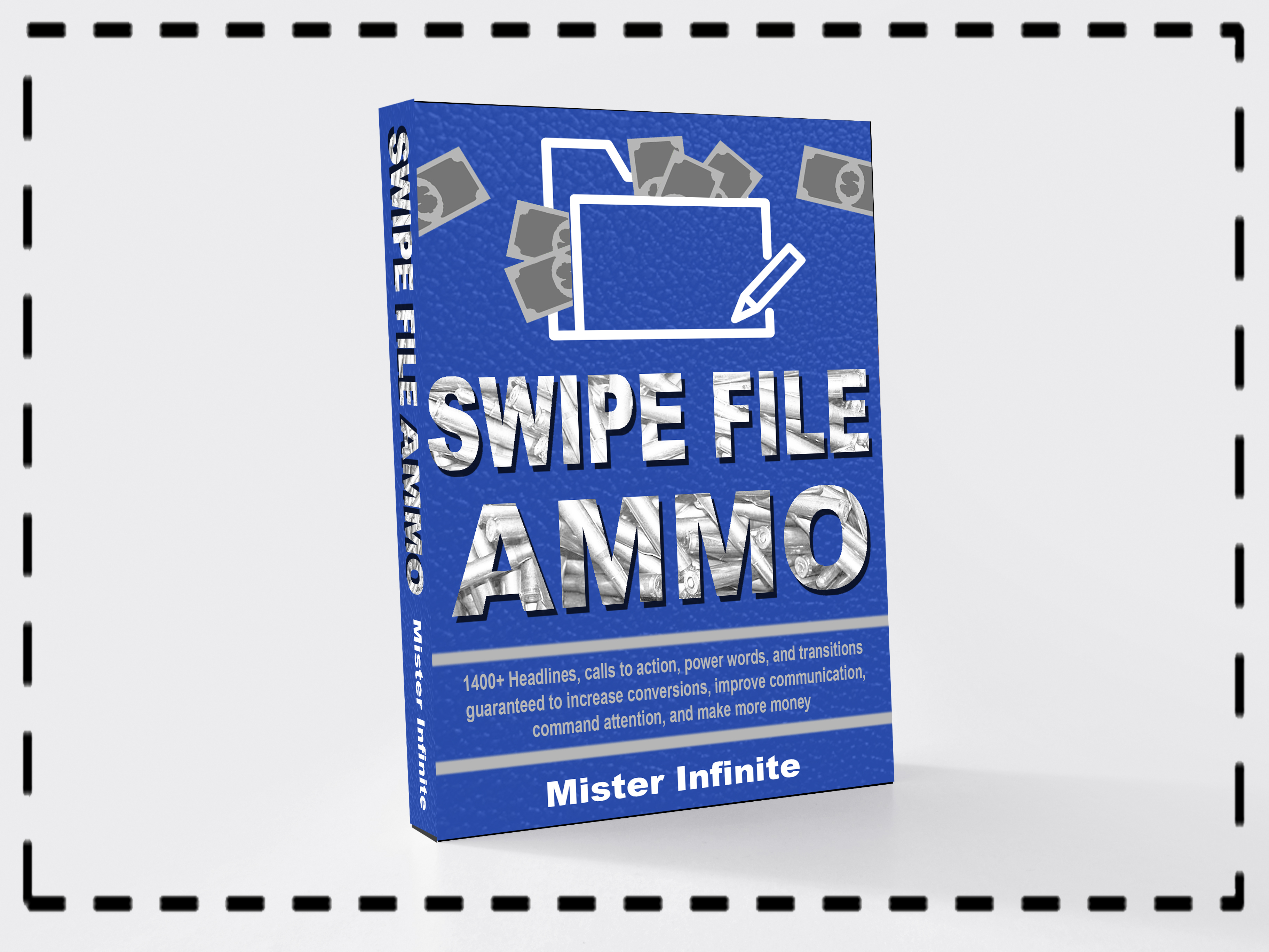
Check out “Swipe File Ammo“.
It’s full of 1400+ headlines, calls to action, power words, and transitions to help increase conversions, improve communication, and command attention.
You May Also Like:
Why Eugene Schwartz’s Copywriting Philosophy Still Beats Modern Funnels
The Chemistry of Persuasion: How to Speak to the Mind Beneath the Mind
The Art and Science of Converting Cold Traffic
Inside: The Content Structures That Quietly Rewire How People Think
Crafting Winning Angles: The Secret to Effective Marketing
Robert DeNiro: Profitable and Timeless Communication Principles
The Hidden Psychology That Controls What Things Feel Worth
Unraveling the History of Direct Response Marketing

My name is Mister Infinite. I've written 778+ articles for people who want more out of life. Within this website you will find the motivation and action steps to live a higher quality lifestyle.
- Mister Infinite
- Mister Infinite
- Mister Infinite
- Mister Infinite
- Mister Infinite
- Mister Infinite
- Mister Infinite
- Mister Infinite
- Mister Infinite
- Mister Infinite
- Mister Infinite
- Mister Infinite
- Mister Infinite
- Mister Infinite
- Mister Infinite
- Mister Infinite
- Mister Infinite
- Mister Infinite
- Mister Infinite
- Mister Infinite
- Mister Infinite
- Mister Infinite
- Mister Infinite
- Mister Infinite
- Mister Infinite
- Mister Infinite
- Mister Infinite
- Mister Infinite
- Mister Infinite
- Mister Infinite
- Mister Infinite
- Mister Infinite
- Mister Infinite
- Mister Infinite
- Mister Infinite
- Mister Infinite
- Mister Infinite
- Mister Infinite
- Mister Infinite
- Mister Infinite
- Mister Infinite
- Mister Infinite
- Mister Infinite
- Mister Infinite
- Mister Infinite
- Mister Infinite
- Mister Infinite
- Mister Infinite
- Mister Infinite
- Mister Infinite
- Mister Infinite
- Mister Infinite
- Mister Infinite
- Mister Infinite
- Mister Infinite
- Mister Infinite
- Mister Infinite
- Mister Infinite
- Mister Infinite
- Mister Infinite
- Mister Infinite
- Mister Infinite
- Mister Infinite
- Mister Infinite
- Mister Infinite
- Mister Infinite
- Mister Infinite
- Mister Infinite
- Mister Infinite
- Mister Infinite
- Mister Infinite
- Mister Infinite
- Mister Infinite
- Mister Infinite
- Mister Infinite
- Mister Infinite
- Mister Infinite
- Mister Infinite
- Mister Infinite
- Mister Infinite
- Mister Infinite
- Mister Infinite
- Mister Infinite
- Mister Infinite
- Mister Infinite
- Mister Infinite
- Mister Infinite
- Mister Infinite
- Mister Infinite
- Mister Infinite
- Mister Infinite
- Mister Infinite
- Mister Infinite
- Mister Infinite
- Mister Infinite
- Mister Infinite
- Mister Infinite
- Mister Infinite
- Mister Infinite
- Mister Infinite
- Mister Infinite
- Mister Infinite
- Mister Infinite
- Mister Infinite
- Mister Infinite
- Mister Infinite
- Mister Infinite
- Mister Infinite
- Mister Infinite
- Mister Infinite
- Mister Infinite
- Mister Infinite
- Mister Infinite
- Mister Infinite
- Mister Infinite
- Mister Infinite
- Mister Infinite
- Mister Infinite
- Mister Infinite
- Mister Infinite
- Mister Infinite
- Mister Infinite
- Mister Infinite
- Mister Infinite
- Mister Infinite
- Mister Infinite
- Mister Infinite
- Mister Infinite
- Mister Infinite
- Mister Infinite
- Mister Infinite
- Mister Infinite
- Mister Infinite
- Mister Infinite
- Mister Infinite
- Mister Infinite
- Mister Infinite
- Mister Infinite
- Mister Infinite
- Mister Infinite
- Mister Infinite
- Mister Infinite
- Mister Infinite
- Mister Infinite
- Mister Infinite
- Mister Infinite
- Mister Infinite
- Mister Infinite
- Mister Infinite
- Mister Infinite
- Mister Infinite
- Mister Infinite
- Mister Infinite
- Mister Infinite
- Mister Infinite
- Mister Infinite
- Mister Infinite
- Mister Infinite
- Mister Infinite
- Mister Infinite
- Mister Infinite
- Mister Infinite
- Mister Infinite
- Mister Infinite
- Mister Infinite
- Mister Infinite
- Mister Infinite
- Mister Infinite
- Mister Infinite
- Mister Infinite
- Mister Infinite
- Mister Infinite
- Mister Infinite
- Mister Infinite
- Mister Infinite
- Mister Infinite
- Mister Infinite
- Mister Infinite
- Mister Infinite
- Mister Infinite
- Mister Infinite
- Mister Infinite
- Mister Infinite
- Mister Infinite
- Mister Infinite
- Mister Infinite
- Mister Infinite
- Mister Infinite
- Mister Infinite
- Mister Infinite
- Mister Infinite
- Mister Infinite
- Mister Infinite
- Mister Infinite
- Mister Infinite
- Mister Infinite
- Mister Infinite
- Mister Infinite
- Mister Infinite
- Mister Infinite
- Mister Infinite
- Mister Infinite
- Mister Infinite
- Mister Infinite
- Mister Infinite
- Mister Infinite
- Mister Infinite
- Mister Infinite
- Mister Infinite
- Mister Infinite
- Mister Infinite
- Mister Infinite
- Mister Infinite
- Mister Infinite
- Mister Infinite
- Mister Infinite
- Mister Infinite
- Mister Infinite
- Mister Infinite
- Mister Infinite
- Mister Infinite
- Mister Infinite
- Mister Infinite
- Mister Infinite
- Mister Infinite
- Mister Infinite
- Mister Infinite
- Mister Infinite
- Mister Infinite
- Mister Infinite
- Mister Infinite
- Mister Infinite
- Mister Infinite
- Mister Infinite
- Mister Infinite
- Mister Infinite
- Mister Infinite
- Mister Infinite
- Mister Infinite
- Mister Infinite
- Mister Infinite
- Mister Infinite
- Mister Infinite
- Mister Infinite
- Mister Infinite
- Mister Infinite
- Mister Infinite
- Mister Infinite
- Mister Infinite
- Mister Infinite
- Mister Infinite
- Mister Infinite
- Mister Infinite
- Mister Infinite
- Mister Infinite
- Mister Infinite
- Mister Infinite
- Mister Infinite
- Mister Infinite
- Mister Infinite
- Mister Infinite
- Mister Infinite
- Mister Infinite
- Mister Infinite
- Mister Infinite
- Mister Infinite
- Mister Infinite
- Mister Infinite
- Mister Infinite
- Mister Infinite
- Mister Infinite
- Mister Infinite
- Mister Infinite
- Mister Infinite
- Mister Infinite
- Mister Infinite
- Mister Infinite
- Mister Infinite
- Mister Infinite
- Mister Infinite
- Mister Infinite
- Mister Infinite
- Mister Infinite
- Mister Infinite
- Mister Infinite
- Mister Infinite
- Mister Infinite
- Mister Infinite
- Mister Infinite
- Mister Infinite
- Mister Infinite
- Mister Infinite
- Mister Infinite
- Mister Infinite
- Mister Infinite
- Mister Infinite
- Mister Infinite
- Mister Infinite
- Mister Infinite
- Mister Infinite
- Mister Infinite
- Mister Infinite
- Mister Infinite
- Mister Infinite
- Mister Infinite
- Mister Infinite
- Mister Infinite
- Mister Infinite
- Mister Infinite
- Mister Infinite
- Mister Infinite
- Mister Infinite
- Mister Infinite
- Mister Infinite
- Mister Infinite
- Mister Infinite
- Mister Infinite
- Mister Infinite
- Mister Infinite
- Mister Infinite
- Mister Infinite
- Mister Infinite
- Mister Infinite
- Mister Infinite
- Mister Infinite
- Mister Infinite
- Mister Infinite
- Mister Infinite
- Mister Infinite
- Mister Infinite
- Mister Infinite
- Mister Infinite
- Mister Infinite
- Mister Infinite
- Mister Infinite
- Mister Infinite
- Mister Infinite
- Mister Infinite
- Mister Infinite
- Mister Infinite
- Mister Infinite
- Mister Infinite
- Mister Infinite
- Mister Infinite
- Mister Infinite
- Mister Infinite
- Mister Infinite
- Mister Infinite
- Mister Infinite
- Mister Infinite
- Mister Infinite
- Mister Infinite
- Mister Infinite
