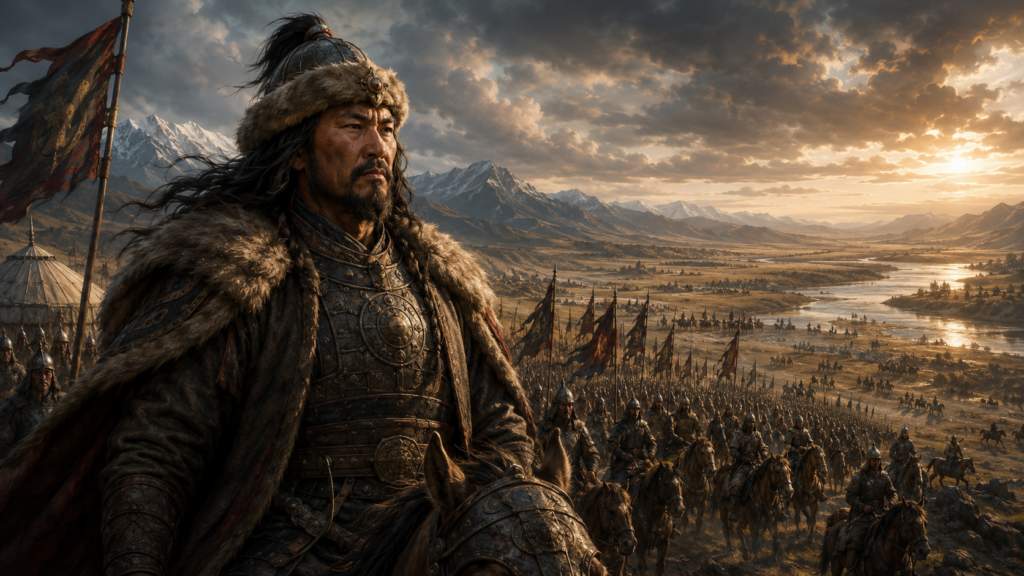
When people think about history’s greatest conquerors, a few names usually come to mind.
- Alexander the Great.
- Julius Caesar.
- Napoleon Bonaparte.
All of them achieved extraordinary things.
Yet none of them built what Genghis Khan built.
At its peak, the Mongol Empire became the largest contiguous land empire in human history.
It stretched from Korea to Eastern Europe.
It conquered more territory than Alexander.
More than Caesar.
More than Napoleon.
And unlike many conquerors, the empire continued expanding after Genghis Khan died.
That last point is important.
- History is full of military geniuses.
- History is full of charismatic leaders.
- History is full of rulers who won spectacular victories.
What is rare is building something that continues working after you’re gone.
That raises an interesting question:
What was Genghis Khan doing differently?
Most people assume it was military strength.
But lots of civilizations possessed strong armies.
The deeper answer lies in how he thought.
His rise was driven by a handful of principles that made him extraordinarily effective.
Ironically, the eventual decline of the empire reveals the one major problem he never fully solved.
He Started With Nothing
One of the biggest differences between Genghis Khan and many famous conquerors is where they started.
Alexander inherited a kingdom.
- He inherited a professional army.
- He inherited experienced generals.
- He inherited wealth.
Much of the foundation for his success had already been built by his father, Philip II.
Genghis Khan inherited almost nothing.
- His father died when he was young.
- His family was abandoned by their tribe.
- They survived through hardship and scarcity.
At one point he was captured and enslaved.
There was no empire waiting for him.
- No treasury.
- No military machine.
- No established power structure.
Everything had to be built from scratch.
This matters because it forced him to think differently.
Alexander learned how to command an existing machine.
Genghis Khan learned how to build one.
Those are very different skills.
One requires leadership.
The other requires architecture.
Throughout his life, Genghis Khan behaved less like a heroic warrior and more like a builder of systems.
That distinction helps explain much of what followed.
Radical Meritocracy
One of Genghis Khan’s greatest advantages was his willingness to promote talent instead of bloodlines.
This sounds obvious today.
At the time, it was revolutionary.
Most societies operated through birthright.
- Your family determined your opportunities.
- Your status determined your future.
- Power flowed through noble families.
Competence was often secondary.
Many rulers filled important positions with:
- Relatives
- Allies
- Or members of powerful families.
This created a predictable problem.
Many important roles were occupied by people who happened to be well connected rather than highly capable.
Genghis Khan largely ignored this model.
He rewarded people based on ability.
If someone was effective, they advanced.
If they weren’t, they didn’t.
It mattered less where someone came from and more what they could actually do.
This dramatically expanded his talent pool.
Most rulers recruited from a narrow slice of society.
Genghis Khan recruited from virtually everyone.
As a result, his inner circle became filled with competent commanders and administrators rather than merely loyal nobles.
This created a huge advantage.
Better people produce better decisions.
Better decisions produce better outcomes.
Many organizations still struggle with this problem today.
- Politics often replaces competence.
- Status replaces performance.
- Connections replace ability.
Genghis Khan understood something timeless:
Results matter more than pedigree.
A Unifying Vision
Military strength alone doesn’t explain what happened.
The Mongol tribes had been fighting one another long before Genghis Khan arrived.
What he accomplished was far bigger than winning battles.
He united competing groups under a common vision.
This is one of the most underrated leadership skills in history.
Many people can issue orders.
Few can get large numbers of people to willingly pursue the same objective.
Genghis Khan had the ability to communicate a future that people wanted to become part of.
There is an old saying:
If one person dreams a dream, it remains a dream.
If many people dream the same dream, it becomes reality.
This captures what he achieved.
He transformed scattered tribes into a unified force.
Alignment is one of the most powerful forces in the world.
When people move in different directions, energy gets wasted.
Resources become fragmented.
Progress slows.
When people move toward the same objective, momentum compounds.
Whether you’re building:
- A company
- A movement
- Or an empire
the principle remains the same.
People follow visions more readily than instructions.
Adaptability Over Tradition
Perhaps the most important trait Genghis Khan possessed was adaptability.
Most leaders become attached to tradition.
They continue doing things a certain way because that’s how they’ve always been done.
Success becomes a trap.
Old victories become invisible chains.
Genghis Khan cared far less about tradition than effectiveness.
- If Chinese engineers had superior siege technology, he adopted it.
- If Persian administrators had better systems of governance, he adopted them.
- If Turkic communication methods improved efficiency, he adopted those too.
His loyalty wasn’t to old methods.
His loyalty was to results.
This sounds simple.
It’s actually rare.
- Most people defend identities.
- Most people defend habits.
- Most people defend tradition.
Genghis Khan defended effectiveness.
Every conquest became an opportunity to learn.
Every encounter became an opportunity to upgrade.
The Mongols weren’t simply conquering territory.
They were absorbing useful knowledge from every civilization they encountered.
This allowed them to improve faster than their rivals.
The people who learn fastest often win fastest.
Information As A Competitive Advantage
Another overlooked reason for Mongol success was information.
Most medieval rulers operated with poor intelligence.
- Information traveled slowly.
- Communication was unreliable.
- Leaders often made decisions with incomplete knowledge.
The Mongols approached things differently.
All soldiers were trained in scouting and intelligence gathering.
Information wasn’t treated as a secondary concern.
It was treated as a strategic weapon.
- Supply chains were continually improved.
- Communication systems were continually improved.
- Messaging networks were continually improved.
The Mongols even maintained an empire-wide postal system.
In many ways, they possessed the best information infrastructure in the known world.
This gave them a tremendous advantage.
The side with better information often makes better decisions.
Better decisions create better outcomes.
Many victories are determined before the battle begins.
They are determined by:
- Positioning.
- Preparation.
- Intelligence.
- Awareness.
- Knowledge.
Genghis Khan understood that information is power.
And he built systems to acquire more of it than his enemies.
Psychological Warfare
Most people think wars are won through force.
Force matters.
But psychology often matters just as much.
Genghis Khan understood this better than most rulers.
- He used fear.
- He used reputation.
- He used deception.
- He used uncertainty.
Stories of Mongol victories spread ahead of the armies themselves.
Entire cities often knew what had happened to previous opponents.
Many chose surrender over resistance.
This created an interesting effect.
The Mongols frequently won battles before they were fought.
The psychological battle had already been won.
- Cities surrendered.
- Resistance weakened.
- Opponents lost morale.
This reduced:
- Casualties.
- Costs.
- Resistance.
And accelerated conquest.
Ironically, fear often saved lives.
A city that surrendered avoided destruction.
A city that resisted faced harsher consequences.
The reputation became a weapon.
This lesson extends beyond warfare.
People don’t simply react to reality.
They react to their perception of reality.
- Perception shapes behavior.
- Expectations shape behavior.
- Narratives shape behavior.
Genghis Khan understood this centuries before modern psychology existed.
Cultural Tolerance
Many conquerors attempted to erase local cultures.
Genghis Khan generally took a different approach.
He allowed conquered peoples to maintain their:
- Religions
- Customs
- And traditions.
This was unusual for the era.
Most rulers attempted to force uniformity.
The Mongols often prioritized stability instead.
This reduced resistance.
People were less likely to rebel when they could continue living according to their own beliefs.
Religious freedom became a practical governance tool.
Tolerance became a strategic advantage.
This mattered because the empire contained an enormous variety of cultures.
Managing such a large territory required flexibility.
You can’t effectively govern millions of people if every group feels threatened.
Genghis Khan understood this.
By allowing cultural autonomy, he made administration easier and resistance weaker.
It wasn’t merely an act of tolerance.
It was smart governance.
A Willingness To Embrace Discomfort
Another factor that separated Genghis Khan from many rivals was his relationship with discomfort.
Most armies preferred favorable conditions.
Most leaders preferred safe conditions.
The Mongols frequently moved when others wouldn’t.
- They crossed frozen rivers.
- They traveled through brutal winters.
- They endured extreme conditions.
Why?
Because hardship created opportunity.
Enemies often assumed movement was impossible.
Defenses relaxed.
Expectations formed.
Then the Mongols appeared.
The temporary discomfort of the journey created strategic surprise at the destination.
Most people seek comfort.
The Mongols often sought effectiveness.
These are not always the same thing.
This lesson appears throughout life.
The path most people avoid often contains the opportunity most people want.
What Made Him Different From Alexander?
Alexander was undoubtedly a military genius.
But Alexander largely inherited the machine he commanded.
Genghis Khan built his.
Alexander often led from the front.
His soldiers loved him because they saw him fighting beside them.
His leadership was deeply personal.
Genghis Khan emphasized:
- Discipline
- Structure
- And organization.
One was a heroic warrior.
The other was an architect.
Alexander’s empire fragmented almost immediately after his death.
The Mongol Empire continued expanding for decades.
That difference reveals something important.
Alexander built victories.
Genghis Khan built systems capable of producing victories.
What Made Him Different From Napoleon?
But Napoleon personally directed much of the military machine.
The system depended heavily on him.
Genghis Khan delegated.
He empowered commanders.
He developed leaders who could operate independently.
Generals like Subutai conducted campaigns thousands of miles away and still achieved extraordinary success.
This is one of the strongest signs of a great organization.
Success becomes repeatable.
The system works without constant supervision.
He built commanders, not merely armies.
The Succession Problem
For all of Genghis Khan’s strengths, there was one major problem he never fully solved.
Succession.
This would become the empire’s greatest weakness.
- He built systems for conquest.
- He built systems for leadership.
- He built systems for military organization.
- He built systems for communication.
But he never created a completely clear and durable solution for transferring power after his death.
This is the classic founder problem.
Building something is difficult.
Building something that survives you is much harder.
Once Genghis Khan died, different regions increasingly pursued their own interests.
- Political priorities diverged.
- Power struggles emerged.
- The empire gradually fragmented.
The machine was powerful.
But the transfer mechanism remained incomplete.
When The Empire Outgrew Governance
Another problem emerged.
The empire grew faster than it could be governed.
The various khanates became increasingly autonomous.
Competition developed between regions.
Succession disputes became common.
Leadership transitions often involved conflict.
- Economic strain increased.
- Taxation increased.
- Administrative complexity increased.
What had once been a unified empire gradually became a collection of increasingly independent powers.
Growth had outpaced governance.
This is a problem many organizations encounter.
Expansion is exciting.
Administration is not.
Yet administration often determines longevity.
When Adaptability Disappeared
Ironically, the quality that helped build the empire slowly faded.
Adaptability.
The early Mongols constantly evolved.
- They absorbed ideas.
- Improved systems.
- Adopted innovations.
- Adapted to changing circumstances.
Later generations became less flexible.
- Military innovation slowed.
- Tactics stagnated.
- The armies that once terrified the world gradually became less formidable.
The adaptability that defined Genghis Khan was no longer as strong in his successors.
This pattern appears constantly throughout history.
The trait that creates success is often abandoned once success arrives.
Personal Charisma Is Not An Institution
There was one final issue.
Genghis Khan himself.
- His charisma was a major asset.
- His leadership was a major asset.
- His ability to unify people was a major asset.
But charismatic founders create hidden risk.
They become the center of gravity.
The organization begins revolving around them.
The moment they disappear, instability increases.
The Mongol Empire continued winning after Genghis Khan died.
But the clock had already started ticking.
The focal point was gone.
Over time, fragmentation increased.
Any organization built primarily around one person’s will eventually faces this challenge.
Charisma is powerful.
Institutions are durable.
The strongest organizations eventually become larger than their founders.
The Real Lesson
Genghis Khan’s rise is a masterclass in:
- Meritocracy
- Adaptability
- Information superiority
- Psychological leverage
- And clarity of vision.
His decline is a masterclass in institutional failure.
His rise was powered by:
- Meritocracy
- Vision
- Adaptability
- Information superiority
- Psychological warfare
- Cultural tolerance
- A willingness to embrace discomfort
His empire’s decline was driven by:
- Succession problems
- Fragmentation
- Loss of adaptability
- Dependence on founding leadership
That is what makes his story so fascinating.
He built the largest contiguous land empire in human history.
He solved many of the hardest problems in conquest.
But he never fully solved the question every founder eventually faces:
What happens when you’re gone?
Because building something is only half the challenge.
Making it last is the other half.
The biggest lesson from Genghis Khan isn’t about conquest.
It’s about seeing the hidden systems that create outcomes.
Most people focus on events.
The best leaders focus on the forces underneath them.
That’s exactly what mental models help you do.
If you want a deeper understanding of the:
- Frameworks
- Patterns
- And decision-making tools
that shape success in:
- Business
- Money
- And life
grab a copy of the Mental Model Playbook.
Inside you’ll discover timeless models for thinking more clearly, making better decisions, and spotting opportunities others miss.
Get the Mental Model Playbook here.
You May Also Like:
"The Book Of Five Rings" - Book Review
The Art of Clarity: Seeing Signal Through the Noise
The Subtle Art of Edges in Poker and Business: Navigating High-Level Play and Decision Making
Mental Models - How To Discover The Hidden Assets Inside Your Own Mind
Mastering Multi-Order Consequences: The Key to Strategic Thinking
The Invisible War That Decides Every Outcome Before It Starts
A Guide to Smarter Decision-Making: Understanding and Applying Positive Expected Value (EV+) Moves
The Strategic Mastery Of Hannibal That Still Applies Today

My name is Mister Infinite. I've written 778+ articles for people who want more out of life. Within this website you will find the motivation and action steps to live a higher quality lifestyle.
