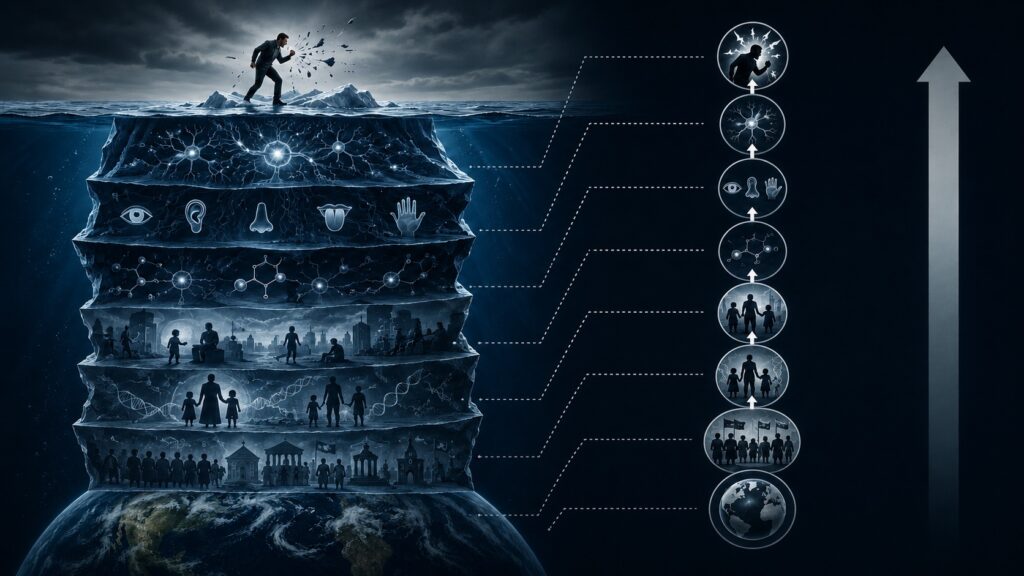
Behavior does not appear out of nowhere.
It arrives at the end of a chain.
A hidden stack of forces was already moving long before the visible action showed up.
The behavior was simply the final output.
Most people only look at the last frame of the movie.
But if you want to understand:
- Power
- Influence
- Psychology
- Business
- Marketing
- Or even yourself
You have to think differently.
You have to move backward.
You have to ask:
What invisible structure quietly made this behavior more likely?
Because behavior is not random.
It’s layered.
And every layer operates on a different timeline.
Let’s go down the stack.
Table of Contents
ToggleThe First Layer: Neurobiology
Imagine someone suddenly loses their temper.
What happened?
Most people say:
“He got mad.”
Not enough.
Go smaller.
What happened one second before?
- Neurons fired.
- Attention shifted.
- Emotional systems reacted.
- Motor systems prepared for action.
At the immediate level, behavior is electrical and chemical.
But stopping here explains almost nothing.
Saying behavior came from neurons is like explaining a car crash by saying:
“Metal moved.”
Technically true.
Practically useless.
You still have to ask:
Why did those neurons fire that way?
Move backward.
The Second Layer: Sensory Inputs
Brains react to information.
Something entered the system.
- A facial expression.
- A smell.
- A tone of voice.
- A phrase.
- A status signal.
- A memory trigger.
People think they react to reality.
Not exactly.
They react to interpretations.
Two people hear identical words.
- One laughs. One feels insulted.
- One feels challenged. One feels inspired.
The nervous system asks:
“Is this safe?”
“Is this dangerous?”
“Does this raise or lower my status?”
“Should I move toward this or away from it?”
But another question appears:
Why was the system so sensitive in the first place?
Move backward.
The Third Layer: Hormones And Internal State
Two people receive the same input.
One stays calm.
One explodes.
Because the internal system itself changed.
Think of hormones as hidden volume knobs.
They alter sensitivity.
Same input.
Different output.
- Stress changes reactions.
- Fatigue changes reactions.
- Sleep changes reactions.
- Isolation changes reactions.
People often think behavior reflects permanent identity.
Many times it reflects temporary state.
But states themselves came from somewhere.
Move backward.
The Fourth Layer: Environment Shapes The Brain
Repeated experiences leave fingerprints.
Conflict creates one nervous system.
Stability creates another.
Ambitious environments create one set of expectations.
Low-agency environments create another.
The nervous system learns terrain.
- What deserves fear.
- What deserves attention.
- What deserves excitement.
Environment becomes architecture.
Architecture becomes behavior.
But environments begin long before adulthood.
Move back.
The Fifth Layer: Childhood, Development, And Genetics
Long before conscious decisions, construction already started.
- Childhood matters.
- Family patterns matter.
- Stress matters.
- Genes matter.
Two people can experience the same event.
Different outcomes emerge.
Why?
Because experience sits on top of architecture.
People often react to present situations through maps built years earlier.
But even these maps exist inside something larger.
Move backward.
The Sixth Layer: Culture Is Software
Culture installs invisible code.
- Rules.
- Values.
- Expectations.
Ideas about:
- Success
- Power
- Masculinity
- Status
- Risk
- Belonging
People think they’re choosing freely.
Sometimes they’re running inherited scripts.
Most people never notice this.
Fish do not notice water.
People rarely notice culture.
But culture itself came from somewhere.
Move backward.
The Seventh Layer: Ecology Creates Culture
- Climate.
- Food supply.
- Geography.
- Disease.
- Conflict.
- Scarcity.
These shape culture.
Culture shapes behavior.
Different environments create different survival strategies.
And those survival strategies become norms.
Now zoom out:
Ecology
↓
Culture
↓
Development
↓
Environment
↓
Hormones
↓
Sensory input
↓
Neural activity
↓
Behavior
Now here is where things get interesting.
Because this isn’t just psychology.
This quietly explains business too.
Why Most Businesses Misunderstand Human Behavior
Most businesses only look at the final output.
- Sales went down.
- Conversion dropped.
- People didn’t buy.
Then they panic.
“Let’s change button colors.”
“Rewrite one headline.”
“Lower price.”
They’re looking at the visible behavior.
But behavior sits at the bottom of a stack.
The better question:
What invisible structure made buying less likely?
Maybe:
- Trust was weak.
- The offer was too generic.
- Timing changed.
- Cultural narratives shifted.
- Attention moved elsewhere.
- Fear increased.
- Competition changed expectations.
The buying behavior was the final output.
The cause began much earlier.
Most businesses troubleshoot symptoms.
Very few examine systems.
Copywriting Is Applied Behavioral Archaeology
Most people think copywriting means writing clever words.
Not really.
Copywriting is tracing behavior backward.
Someone buys.
Why?
Keep asking why.
Maybe they wanted money.
Why?
Why?
Control + Power + Optionality.
Why?
Higher quality of life + Higher Status.
Why?
Greater chance to pass on genes.
Keep digging.
Eventually you stop hearing surface explanations.
You reach emotional infrastructure.
You find the hidden engine.
This is why beginners write:
“Our product has 18 features.”
Experienced copywriters ask:
“What invisible force already exists inside this person?”
People rarely buy products.
They buy movement.
- Movement away from pain.
- Movement toward status.
- Movement toward certainty.
- Movement toward identity.
Good copy finds hidden drivers.
Great copy finds hidden drivers beneath hidden drivers.
Great Salespeople Understand State Changes
People imagine sales as:
- Pressure.
- Talk tracks.
- Scripts.
But behavior depends heavily on state.
State changes perception.
Think about your own life.
Everything looks different when:
- You’re exhausted.
- Confident.
- Lonely.
- Stressed.
- Excited.
The same offer can feel terrible one day and amazing the next.
Because people don’t evaluate reality objectively.
They evaluate reality through state.
Elite salespeople understand this.
They understand:
- Certainty transfers
- Emotion transfers
- Urgency transfers
- Energy transfers
The goal is not forcing decisions.
The goal is changing conditions.
Because conditions shape behavior.
Behavior follows.
Why Markets Suddenly Change
People think markets move because numbers changed.
Not always.
- Narratives change.
- Culture changes.
- Perception changes.
- Meaning changes.
Suddenly everyone sees reality differently.
- Fear spreads.
- Excitement spreads.
- Speculation spreads.
- Behavior shifts.
Markets are human nervous systems operating at scale.
People imagine economics as math.
Often it’s psychology wearing a math costume.
The Hidden Question Behind Everything
People ask:
“Why did this happen?”
Wrong question.
Ask:
What invisible layers quietly made this outcome likely?
Because beneath behavior sits:
- Beliefs
- States
- Environments
- History
- Culture
- Biology
- Incentives
- Hidden structures
The visible action was only the final domino.
And this changes everything.
- It changes how you understand people.
- It changes how you understand yourself.
- It changes how you understand business.
- And it changes how you understand power.
Because once you stop staring at the final output…
You start seeing the machinery underneath.
And the people who see hidden machinery usually control more of reality.
Upgrade The Models Running Your Reality
Most people react to surfaces.
Few learn to see the invisible systems beneath events.
That gap creates massive advantage.
If you want stronger mental models for understanding:
- Psychology
- Leverage
- Money
- Strategy
- And human behavior
explore The Mental Model Playbook.
The better your models, the more reality starts making sense.
You May Also Like:
The Essence Of Game: Creating An Emotional Experience
7 Ways to Stop Worrying What People Think About You
The Intersection of Art and Business Innovation: How Incorporating Artistic Principles Can Lead to U...
The 1-Minute Empathy Hack That Can Help Grow Your Business: Get Inside Your Customer’s Head Instantl...
The Shadow Test: 4 Ways People Reveal Who They Really Are
BRAIN TRANSFER: The Shocking Truth About How Money Actually Moves
Crafting a Winning Sales Letter: A Step-by-Step Guide
What To Do When Your Growth Has You Losing Friends

My name is Mister Infinite. I've written 778+ articles for people who want more out of life. Within this website you will find the motivation and action steps to live a higher quality lifestyle.
- Mister Infinite
- Mister Infinite
- Mister Infinite
- Mister Infinite
- Mister Infinite
- Mister Infinite
- Mister Infinite
- Mister Infinite
- Mister Infinite
- Mister Infinite
- Mister Infinite
- Mister Infinite
- Mister Infinite
- Mister Infinite
- Mister Infinite
- Mister Infinite
- Mister Infinite
- Mister Infinite
- Mister Infinite
- Mister Infinite
- Mister Infinite
- Mister Infinite
- Mister Infinite
- Mister Infinite
- Mister Infinite
- Mister Infinite
- Mister Infinite
- Mister Infinite
- Mister Infinite
- Mister Infinite
- Mister Infinite
- Mister Infinite
- Mister Infinite
- Mister Infinite
- Mister Infinite
- Mister Infinite
- Mister Infinite
- Mister Infinite
- Mister Infinite
- Mister Infinite
- Mister Infinite
- Mister Infinite
- Mister Infinite
- Mister Infinite
- Mister Infinite
- Mister Infinite
- Mister Infinite
- Mister Infinite
- Mister Infinite
- Mister Infinite
- Mister Infinite
- Mister Infinite
- Mister Infinite
- Mister Infinite
- Mister Infinite
- Mister Infinite
- Mister Infinite
- Mister Infinite
- Mister Infinite
- Mister Infinite
- Mister Infinite
- Mister Infinite
- Mister Infinite
- Mister Infinite
- Mister Infinite
- Mister Infinite
- Mister Infinite
- Mister Infinite
- Mister Infinite
- Mister Infinite
- Mister Infinite
- Mister Infinite
- Mister Infinite
- Mister Infinite
- Mister Infinite
- Mister Infinite
- Mister Infinite
- Mister Infinite
- Mister Infinite
- Mister Infinite
- Mister Infinite
- Mister Infinite
- Mister Infinite
- Mister Infinite
- Mister Infinite
- Mister Infinite
- Mister Infinite
- Mister Infinite
- Mister Infinite
- Mister Infinite
- Mister Infinite
- Mister Infinite
- Mister Infinite
- Mister Infinite
- Mister Infinite
- Mister Infinite
- Mister Infinite
- Mister Infinite
- Mister Infinite
- Mister Infinite
- Mister Infinite
- Mister Infinite
- Mister Infinite
- Mister Infinite
- Mister Infinite
- Mister Infinite
- Mister Infinite
- Mister Infinite
- Mister Infinite
- Mister Infinite
- Mister Infinite
- Mister Infinite
- Mister Infinite
- Mister Infinite
- Mister Infinite
- Mister Infinite
- Mister Infinite
- Mister Infinite
- Mister Infinite
- Mister Infinite
- Mister Infinite
- Mister Infinite
- Mister Infinite
- Mister Infinite
- Mister Infinite
- Mister Infinite
- Mister Infinite
- Mister Infinite
- Mister Infinite
- Mister Infinite
- Mister Infinite
- Mister Infinite
- Mister Infinite
- Mister Infinite
- Mister Infinite
- Mister Infinite
- Mister Infinite
- Mister Infinite
- Mister Infinite
- Mister Infinite
- Mister Infinite
- Mister Infinite
- Mister Infinite
- Mister Infinite
- Mister Infinite
- Mister Infinite
- Mister Infinite
- Mister Infinite
- Mister Infinite
- Mister Infinite
- Mister Infinite
- Mister Infinite
- Mister Infinite
- Mister Infinite
- Mister Infinite
- Mister Infinite
- Mister Infinite
- Mister Infinite
- Mister Infinite
- Mister Infinite
- Mister Infinite
- Mister Infinite
- Mister Infinite
- Mister Infinite
- Mister Infinite
- Mister Infinite
- Mister Infinite
- Mister Infinite
- Mister Infinite
- Mister Infinite
- Mister Infinite
- Mister Infinite
- Mister Infinite
- Mister Infinite
- Mister Infinite
- Mister Infinite
- Mister Infinite
- Mister Infinite
- Mister Infinite
- Mister Infinite
- Mister Infinite
- Mister Infinite
- Mister Infinite
- Mister Infinite
- Mister Infinite
- Mister Infinite
- Mister Infinite
- Mister Infinite
- Mister Infinite
- Mister Infinite
- Mister Infinite
- Mister Infinite
- Mister Infinite
- Mister Infinite
- Mister Infinite
- Mister Infinite
- Mister Infinite
- Mister Infinite
- Mister Infinite
- Mister Infinite
- Mister Infinite
- Mister Infinite
- Mister Infinite
- Mister Infinite
- Mister Infinite
- Mister Infinite
- Mister Infinite
- Mister Infinite
- Mister Infinite
- Mister Infinite
- Mister Infinite
- Mister Infinite
- Mister Infinite
- Mister Infinite
- Mister Infinite
- Mister Infinite
- Mister Infinite
- Mister Infinite
- Mister Infinite
- Mister Infinite
- Mister Infinite
- Mister Infinite
- Mister Infinite
- Mister Infinite
- Mister Infinite
- Mister Infinite
- Mister Infinite
- Mister Infinite
- Mister Infinite
- Mister Infinite
- Mister Infinite
- Mister Infinite
- Mister Infinite
- Mister Infinite
- Mister Infinite
- Mister Infinite
- Mister Infinite
- Mister Infinite
- Mister Infinite
- Mister Infinite
- Mister Infinite
- Mister Infinite
- Mister Infinite
- Mister Infinite
- Mister Infinite
- Mister Infinite
- Mister Infinite
- Mister Infinite
- Mister Infinite
- Mister Infinite
- Mister Infinite
- Mister Infinite
- Mister Infinite
- Mister Infinite
- Mister Infinite
- Mister Infinite
- Mister Infinite
- Mister Infinite
- Mister Infinite
- Mister Infinite
- Mister Infinite
- Mister Infinite
- Mister Infinite
- Mister Infinite
- Mister Infinite
- Mister Infinite
- Mister Infinite
- Mister Infinite
- Mister Infinite
- Mister Infinite
- Mister Infinite
- Mister Infinite
- Mister Infinite
- Mister Infinite
- Mister Infinite
- Mister Infinite
- Mister Infinite
- Mister Infinite
- Mister Infinite
- Mister Infinite
- Mister Infinite
- Mister Infinite
- Mister Infinite
- Mister Infinite
- Mister Infinite
- Mister Infinite
- Mister Infinite
- Mister Infinite
- Mister Infinite
- Mister Infinite
- Mister Infinite
- Mister Infinite
- Mister Infinite
- Mister Infinite
- Mister Infinite
- Mister Infinite
- Mister Infinite
- Mister Infinite
- Mister Infinite
- Mister Infinite
- Mister Infinite
- Mister Infinite
- Mister Infinite
- Mister Infinite
- Mister Infinite
- Mister Infinite
- Mister Infinite
- Mister Infinite
- Mister Infinite
- Mister Infinite
- Mister Infinite
- Mister Infinite
- Mister Infinite
- Mister Infinite
- Mister Infinite
- Mister Infinite
- Mister Infinite
- Mister Infinite
- Mister Infinite
- Mister Infinite
- Mister Infinite
- Mister Infinite
- Mister Infinite
- Mister Infinite
- Mister Infinite
- Mister Infinite
- Mister Infinite
- Mister Infinite
- Mister Infinite
- Mister Infinite
- Mister Infinite
- Mister Infinite
- Mister Infinite
- Mister Infinite
- Mister Infinite
- Mister Infinite
- Mister Infinite
- Mister Infinite
- Mister Infinite
- Mister Infinite
- Mister Infinite
- Mister Infinite
- Mister Infinite
- Mister Infinite
- Mister Infinite
- Mister Infinite
- Mister Infinite
- Mister Infinite
- Mister Infinite
- Mister Infinite
- Mister Infinite
- Mister Infinite
