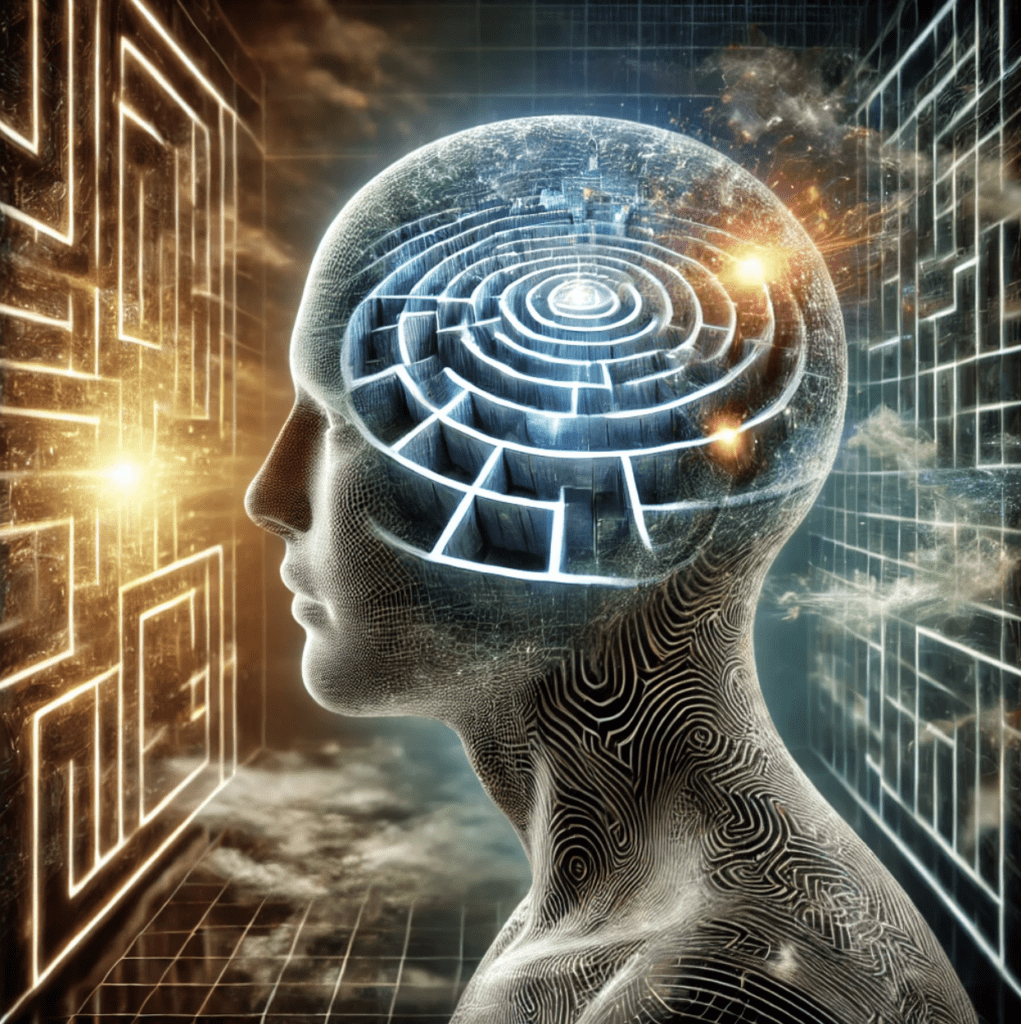
You move through the world in two ways.
With your body.
And with your mind.
Most people only notice the first one.
But the second one decides everything.
Scientists call it your cognitive map.
It’s your internal model of reality.
It tells you:
-
What is possible
-
What is dangerous
-
What is “realistic”
-
What is out of reach
- What is “normal“
You do not see the world as it is.
You see the world as your map allows.
And that map is not accurate.
It’s a virtual reality simulation built inside your nervous system.
It feels real.
But it’s not.
This is why two people can walk through the same street, face the same market, and live in two different universes.
This article breaks down why your cognitive map does not match reality, and how:
-
Psychology
-
And culture
silently rewrite your perception without your consent.
Table of Contents
ToggleThe Nature of Cognitive Maps
Your cognitive map is your brain’s working model of reality.
It helps you:
-
Navigate space
-
Remember locations
-
Make plans
-
Predict outcomes
The idea came from psychologist Edward Tolman in the 1940s.
He showed that rats don’t just react to mazes.
They build internal maps of them.
People do the same thing.
But here’s the critical truth.
Your cognitive map is not a photograph.
It’s a construction.
It’s shaped by:
-
Experience
-
Emotion
-
Memory
-
Conditioning
It doesn’t show you reality.
It shows you your interpretation of reality.
And those interpretations decide:
-
What you attempt
-
What you avoid
-
What you call impossible
-
What you never even consider
Your perceived choices become your real choices.
And those choices become your life.
Perceptual Limitations
Your senses are the raw feed used to build your cognitive map.
But your senses are flawed.
Vision alone is affected by:
-
Light
-
Distance
-
Motion
-
Angle
Optical illusions prove this instantly.
The Müller Lyer illusion shows two equal lines that look different in length just because of arrow direction.
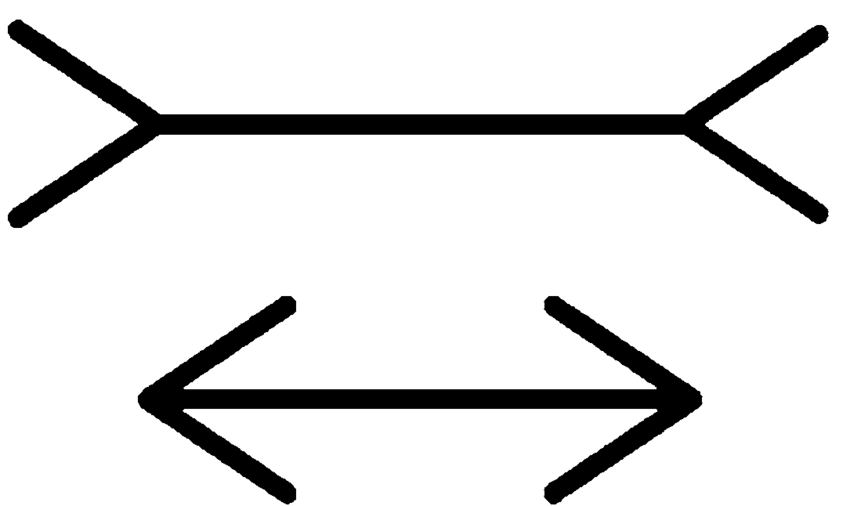
Your brain does not measure reality.
It guesses.
Sound works the same way.
The McGurk effect shows that your brain can hear a sound that doesn’t exist just because a mouth movement suggests it.
What this means is simple.
The data entering your mind is already warped before you think a single thought.
Your map starts distorted at the input level.
Cognitive Biases and Heuristics
These shortcuts are called heuristics.
They save time.
They also ruin accuracy.
One of the strongest is the anchoring effect.
The first number you see becomes the reference point for everything after it.
Not because it’s correct.
Because it arrived first.
That means your map of:
can be built on a lie that entered five seconds too early.
Another distortion is egocentric bias.
You remember events as if you were the center of them.
You inflate the importance of what connects to you.
You shrink what does not.
This distorts:
-
Memory
-
Spatial awareness
-
Meaning
Your map becomes self centered.
Not accurate.
Neurological Constraints
Your brain has hardware limits.
The hippocampus is a key structure for maps and memory.
Damage it and navigation collapses.
This is why Alzheimer’s patients get lost in places they lived in for decades.
Your brain also rewires itself constantly.
This is neuroplasticity.
Every new habit reshapes your internal map.
Every repeated thought deepens its groove.
If new information clashes with the old map, your brain often rejects the new data instead of updating the map.
That creates blind spots.
Blind spots feel like certainty.
Social and Cultural Influences
You didn’t build your first cognitive map.
You inherited it.
Culture tells your brain what to notice.
What to ignore.
What matters.
What doesn’t.
Some Indigenous Australian cultures use only cardinal directions:
-
North
-
South
-
East
-
West
They don’t use:
-
Left
-
Right
-
Front
-
Back
That means their brains encode space differently from childhood.
Their maps are built on global orientation, not body position.
Language does this everywhere.
This is called linguistic relativity.
The words you have shape what you can see.
If your language has more spatial detail, your perception becomes sharper.
If your language is vague, your perception becomes blurry.
You don’t just speak your language.
You think inside it.
Environmental Survival and Language Encoding
Now look at Arctic cultures.
In Inuit and Eskimo Aleut languages, there are many words for snow and ice.
Not for poetry.
For survival.
To outsiders, snow looks like one thing.
To someone living on ice, the difference between:
-
Safe snow
-
Slush
-
Wind packed snow
-
Melting snow
-
Ice crust
can decide:
-
Travel or death
-
Food or starvation
-
Safety or falling through the ice
The environment forced their language to evolve with high resolution.
And language trained the brain to detect those differences automatically.
Their cognitive map of snow is deeper than yours.
Not because they’re smarter.
Because necessity upgraded their perception.
This proves a brutal rule.
Your environment decides what your mind learns to see.
Emotional and Psychological Factors
Your emotions edit your map in real time.
Fear stretches space.
Anxiety makes threats feel closer and larger than they are.
This is called affective realism.
Your emotions don’t just react to reality.
Past trauma does the same thing.
If someone was attacked in one location, their brain can flag that entire area as dangerous forever.
The danger might be gone.
The map stays poisoned.
This is how people become trapped in outdated realities.
Not because the world didn’t change.
Because their map refused to.
Implications and Applications
Once you understand this, you can’t unsee it.
Urban planners use this to design cities that feel navigable, not just logical.
Psychologists use this to rewire anxiety through exposure.
Business uses this to shape how people perceive:
- Value
- Risk
- And urgency.
But the most important implication is personal.
Your success depends on the quality of your map.
If you’re stuck, your map is under built.
If you under-charge, your map of value is broken.
If you fear action, your map of risk is inflated.
If you miss leverage, your map of opportunity is blind.
You can’t outperform the resolution of your perception.
Conclusion
Your cognitive map is not reality.
It’s a working model.
It’s shaped by:
-
Sense limits
-
Culture
-
Emotion
It feels accurate.
That doesn’t mean it is.
Every day, people live inside maps built by:
-
Reinforced belief
And mistake those maps for the world.
The rare ones upgrade their map on purpose.
They rewire perception.
They sharpen resolution.
They stop trusting first impressions.
They stop calling comfort realism.
Reality does not change for them.
Their map does.
And once your map changes, your life follows.
Want to learn how to build better cognitive maps?
Read “Timeline Meditations“.
It’s a collection of golden maxims designed to help you grow.
Enjoy.
-M.I.
You May Also Like:
The Binary Code of Reality: Why You’re Either Running on Fear or Faith (and How to Switch for Quantu...
7 Samurai Code Rules That Make You Dangerous
The Hidden Power of Your Mind: How Consciousness Colors Every Experience You Have
How To Improve Presence Of Mind (And Become Unbreakable)
How to Spot Breakthroughs Before Anyone Else Does: The Hidden Law of Discordant Notes
The Illusion of Linearity: Understanding Nature's True Patterns
Who Are You Really? The Surprising Truth About Your Identity
The Hidden Laboratory: Unusual Places Where Great Ideas Are Born

My name is Mister Infinite. I've written 778+ articles for people who want more out of life. Within this website you will find the motivation and action steps to live a higher quality lifestyle.
- Mister Infinite
- Mister Infinite
- Mister Infinite
- Mister Infinite
- Mister Infinite
- Mister Infinite
- Mister Infinite
- Mister Infinite
- Mister Infinite
- Mister Infinite
- Mister Infinite
- Mister Infinite
- Mister Infinite
- Mister Infinite
- Mister Infinite
- Mister Infinite
- Mister Infinite
- Mister Infinite
- Mister Infinite
- Mister Infinite
- Mister Infinite
- Mister Infinite
- Mister Infinite
- Mister Infinite
- Mister Infinite
- Mister Infinite
- Mister Infinite
- Mister Infinite
- Mister Infinite
- Mister Infinite
- Mister Infinite
- Mister Infinite
- Mister Infinite
- Mister Infinite
- Mister Infinite
- Mister Infinite
- Mister Infinite
- Mister Infinite
- Mister Infinite
- Mister Infinite
- Mister Infinite
- Mister Infinite
- Mister Infinite
- Mister Infinite
- Mister Infinite
- Mister Infinite
- Mister Infinite
- Mister Infinite
- Mister Infinite
- Mister Infinite
- Mister Infinite
- Mister Infinite
- Mister Infinite
- Mister Infinite
- Mister Infinite
- Mister Infinite
- Mister Infinite
- Mister Infinite
- Mister Infinite
- Mister Infinite
- Mister Infinite
- Mister Infinite
- Mister Infinite
- Mister Infinite
- Mister Infinite
- Mister Infinite
- Mister Infinite
- Mister Infinite
- Mister Infinite
- Mister Infinite
- Mister Infinite
- Mister Infinite
- Mister Infinite
- Mister Infinite
- Mister Infinite
- Mister Infinite
- Mister Infinite
- Mister Infinite
- Mister Infinite
- Mister Infinite
- Mister Infinite
- Mister Infinite
- Mister Infinite
- Mister Infinite
- Mister Infinite
- Mister Infinite
- Mister Infinite
- Mister Infinite
- Mister Infinite
- Mister Infinite
- Mister Infinite
- Mister Infinite
- Mister Infinite
- Mister Infinite
- Mister Infinite
- Mister Infinite
- Mister Infinite
- Mister Infinite
- Mister Infinite
- Mister Infinite
- Mister Infinite
- Mister Infinite
- Mister Infinite
- Mister Infinite
- Mister Infinite
- Mister Infinite
- Mister Infinite
- Mister Infinite
- Mister Infinite
- Mister Infinite
- Mister Infinite
- Mister Infinite
- Mister Infinite
- Mister Infinite
- Mister Infinite
- Mister Infinite
- Mister Infinite
- Mister Infinite
- Mister Infinite
- Mister Infinite
- Mister Infinite
- Mister Infinite
- Mister Infinite
- Mister Infinite
- Mister Infinite
- Mister Infinite
- Mister Infinite
- Mister Infinite
- Mister Infinite
- Mister Infinite
- Mister Infinite
- Mister Infinite
- Mister Infinite
- Mister Infinite
- Mister Infinite
- Mister Infinite
- Mister Infinite
- Mister Infinite
- Mister Infinite
- Mister Infinite
- Mister Infinite
- Mister Infinite
- Mister Infinite
- Mister Infinite
- Mister Infinite
- Mister Infinite
- Mister Infinite
- Mister Infinite
- Mister Infinite
- Mister Infinite
- Mister Infinite
- Mister Infinite
- Mister Infinite
- Mister Infinite
- Mister Infinite
- Mister Infinite
- Mister Infinite
- Mister Infinite
- Mister Infinite
- Mister Infinite
- Mister Infinite
- Mister Infinite
- Mister Infinite
- Mister Infinite
- Mister Infinite
- Mister Infinite
- Mister Infinite
- Mister Infinite
- Mister Infinite
- Mister Infinite
- Mister Infinite
- Mister Infinite
- Mister Infinite
- Mister Infinite
- Mister Infinite
- Mister Infinite
- Mister Infinite
- Mister Infinite
- Mister Infinite
- Mister Infinite
- Mister Infinite
- Mister Infinite
- Mister Infinite
- Mister Infinite
- Mister Infinite
- Mister Infinite
- Mister Infinite
- Mister Infinite
- Mister Infinite
- Mister Infinite
- Mister Infinite
- Mister Infinite
- Mister Infinite
- Mister Infinite
- Mister Infinite
- Mister Infinite
- Mister Infinite
- Mister Infinite
- Mister Infinite
- Mister Infinite
- Mister Infinite
- Mister Infinite
- Mister Infinite
- Mister Infinite
- Mister Infinite
- Mister Infinite
- Mister Infinite
- Mister Infinite
- Mister Infinite
- Mister Infinite
- Mister Infinite
- Mister Infinite
- Mister Infinite
- Mister Infinite
- Mister Infinite
- Mister Infinite
- Mister Infinite
- Mister Infinite
- Mister Infinite
- Mister Infinite
- Mister Infinite
- Mister Infinite
- Mister Infinite
- Mister Infinite
- Mister Infinite
- Mister Infinite
- Mister Infinite
- Mister Infinite
- Mister Infinite
- Mister Infinite
- Mister Infinite
- Mister Infinite
- Mister Infinite
- Mister Infinite
- Mister Infinite
- Mister Infinite
- Mister Infinite
- Mister Infinite
- Mister Infinite
- Mister Infinite
- Mister Infinite
- Mister Infinite
- Mister Infinite
- Mister Infinite
- Mister Infinite
- Mister Infinite
- Mister Infinite
- Mister Infinite
- Mister Infinite
- Mister Infinite
- Mister Infinite
- Mister Infinite
- Mister Infinite
- Mister Infinite
- Mister Infinite
- Mister Infinite
- Mister Infinite
- Mister Infinite
- Mister Infinite
- Mister Infinite
- Mister Infinite
- Mister Infinite
- Mister Infinite
- Mister Infinite
- Mister Infinite
- Mister Infinite
- Mister Infinite
- Mister Infinite
- Mister Infinite
- Mister Infinite
- Mister Infinite
- Mister Infinite
- Mister Infinite
- Mister Infinite
- Mister Infinite
- Mister Infinite
- Mister Infinite
- Mister Infinite
- Mister Infinite
- Mister Infinite
- Mister Infinite
- Mister Infinite
- Mister Infinite
- Mister Infinite
- Mister Infinite
- Mister Infinite
- Mister Infinite
- Mister Infinite
- Mister Infinite
- Mister Infinite
- Mister Infinite
- Mister Infinite
- Mister Infinite
- Mister Infinite
- Mister Infinite
- Mister Infinite
- Mister Infinite
- Mister Infinite
- Mister Infinite
- Mister Infinite
- Mister Infinite
- Mister Infinite
- Mister Infinite
- Mister Infinite
- Mister Infinite
- Mister Infinite
- Mister Infinite
- Mister Infinite
- Mister Infinite
- Mister Infinite
- Mister Infinite
- Mister Infinite
- Mister Infinite
- Mister Infinite
- Mister Infinite
- Mister Infinite
- Mister Infinite
- Mister Infinite
- Mister Infinite
- Mister Infinite
- Mister Infinite
- Mister Infinite
- Mister Infinite
- Mister Infinite
- Mister Infinite
- Mister Infinite
- Mister Infinite
- Mister Infinite
- Mister Infinite
- Mister Infinite
- Mister Infinite
- Mister Infinite
- Mister Infinite
- Mister Infinite
- Mister Infinite
- Mister Infinite
- Mister Infinite
- Mister Infinite
- Mister Infinite
- Mister Infinite
- Mister Infinite
- Mister Infinite
- Mister Infinite
- Mister Infinite
- Mister Infinite
- Mister Infinite
- Mister Infinite
- Mister Infinite
- Mister Infinite
- Mister Infinite
- Mister Infinite
- Mister Infinite
