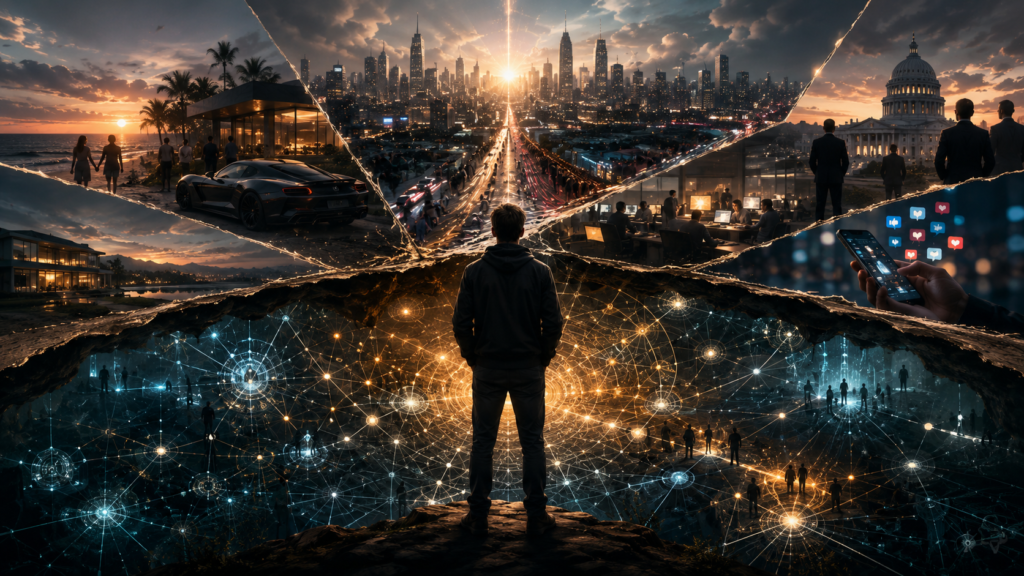
Most people walk through life seeing the surface.
They see:
- Money.
- People.
- Jobs.
- Politics.
- Technology.
- Relationships.
- Success.
- Failure.
But underneath all of these things are invisible systems.
Once you learn how those systems work, reality starts looking very different.
You stop seeing isolated events.
You start seeing:
- Patterns.
- Incentives.
- Feedback loops.
- Signals.
- Networks.
- Power structures.
- And hidden forces shaping what happens next.
This is why learning across different fields is so powerful.
You don’t need a PhD in any of them.
You just need enough knowledge to steal the mental models they contain.
Here are 10 fields that can completely change the way you see reality.
1. Game Theory
Game theory teaches you that behavior doesn’t happen in a vacuum.
People make decisions based on what they expect other people to do.
Imagine two businesses competing in the same market.
One lowers its prices.
The other now has to decide:
- Do we lower ours too?
- Maintain our price?
- Change the product?
- Target a different customer?
The correct move depends on what the competitor is likely to do next.
Now apply this to:
- Business.
- Dating.
- Negotiation.
- Politics.
- Friendships.
- War.
- Social status.
Suddenly, behavior becomes much easier to understand.
You start asking:
Because the stated game and the real game aren’t always the same.
- Someone may say they want cooperation while their incentives reward competition.
- Someone may preach loyalty while constantly rewarding betrayal.
- Someone may claim they want honesty while punishing anyone who tells them the truth.
Game theory teaches you to stop judging systems by what people say they want.
Look at the payoff structure.
The incentives often reveal the real game.
2. Evolutionary Psychology
Evolutionary psychology forces you to look underneath modern behavior.
People have:
- The Internet
- Smartphones
- Skyscrapers
- Airplanes
- And AI.
But our nervous systems were shaped across a much older environment.
That matters.
Many modern behaviors make more sense when you understand ancient pressures involving:
- Survival.
- Status.
- Sex.
- Belonging.
- Resources.
- Threat detection.
- Tribal loyalty.
- Mate selection.
Why are people obsessed with status?
Why does social approval feel rewarding?
Why do people form tribes so easily?
Why do people constantly compare themselves to others?
These behaviors didn’t appear randomly.
They were shaped by environments where being accepted by your group could have major consequences for survival and reproduction.
The modern world changed incredibly fast.
Once you understand that mismatch, a lot of strange modern behavior starts making sense.
You begin seeing the ancient machine operating underneath the modern costume.
3. Information Theory
Information theory changes how you think about communication.
At its core, communication involves sending a signal through noise.
The clearer the signal, the easier it is to receive.
This sounds simple.
But look around.
Modern life is drowning in noise.
- Notifications.
- Ads.
- Emails.
- Videos.
- Opinions.
- News.
- Memes.
- Messages.
Everyone is fighting for bandwidth.
This means attention becomes incredibly valuable.
The person who can communicate a strong signal through massive amounts of noise has power.
That’s why:
- Clear brands win.
- Strong headlines win.
- Simple ideas spread.
- Distinct personalities get remembered.
- Memorable stories survive.
- Confusing signals disappear.
Information theory also teaches you something deeper:
Information has value because it reduces uncertainty.
If everyone knows something, it usually has less informational advantage.
If almost nobody knows something important, it can become extremely valuable.
This is why obscure knowledge can create massive leverage.
4. Systems Thinking
Most people think in straight lines.
A causes B.
But reality rarely works that cleanly.
Reality is made of systems.
Systems contain:
- Inputs.
- Outputs.
- Feedback loops.
- Delays.
- Bottlenecks.
- Second-order effects.
- And unintended consequences.
Imagine someone wants more customers.
They increase advertising.
More customers arrive.
But customer support can’t handle the volume.
- Service quality falls.
- Reviews get worse.
- Refunds increase.
- Reputation declines.
- Eventually sales fall.
The original action “worked.”
But the system failed.
Systems thinking trains you to ask:
“And then what?”
And after that?
And after that?
You stop optimizing individual pieces while destroying the whole machine.
This applies to:
- Health.
- Money.
- Business.
- Relationships.
- Cities.
- Ecology.
- Organizations.
Your entire life is a collection of interconnected systems.
Learn to see the loops and you stop being surprised by many of the outcomes.
5. Behavioral Economics
Traditional economics often assumes people behave rationally.
Behavioral economics shows how messy that assumption can be.
People use shortcuts.
- We anchor.
- We follow crowds.
- We hate losses.
- We overweight recent information.
- We become attached to things simply because we own them.
- We judge value relative to other options.
This changes how you understand buying behavior.
Imagine seeing a jacket for $300.
Expensive.
Now imagine seeing:
- $1,200 jacket.
- $800 jacket.
- $300 jacket.
Suddenly the same $300 can feel completely different.
The product didn’t change.
The frame changed.
Once you understand behavioral economics, you start noticing invisible frames everywhere.
- Pricing.
- Menus.
- Sales pages.
- Political messaging.
- Negotiations.
- Stores.
- Apps.
- Social media.
People aren’t simply reacting to reality.
They’re reacting to how reality is presented to them.
6. Cybernetics
Cybernetics is the study of:
- Control
- Communication
- And feedback in systems.
One of its most useful ideas is incredibly simple:
You don’t reach a target through perfect prediction.
You reach it through continuous correction.
Think about driving.
You don’t perfectly calculate every movement before leaving your house.
- You steer.
- Observe.
- Correct.
- Steer.
- Observe.
- Correct.
That’s a feedback loop.
Your thermostat works similarly.
Target temperature: 70°F.
Current temperature: 66°F.
Turn heat on.
Current temperature reaches 70°F.
Turn heat off.
This same principle applies to personal growth.
You have:
Desired state → action → feedback → correction → new action.
The problem is that people often remove the feedback.
- They don’t measure their money.
- They don’t track their business.
- They don’t examine their habits.
- They don’t ask why something failed.
Then they wonder why they keep missing the target.
Cybernetics teaches you that intelligence isn’t merely knowing what to do.
It’s being able to correct yourself.
7. Network Science
Network science teaches you that your position inside a system can matter almost as much as your individual ability.
Imagine two equally talented people.
Person A knows 10 people who know the same 10 people.
Person B is connected to people across:
- Finance.
- Technology.
- Entertainment.
- Real estate.
- Media.
- Fashion.
- Startups.
Person B has access to far more information and opportunity.
Not necessarily because he’s smarter.
Because of his position in the network.
Networks determine how:
- Information spreads.
- Trends emerge.
- Diseases travel.
- Ideas become popular.
- Opportunities move.
- Reputations form.
- Capital flows.
This is why certain people constantly seem to be “in the right place at the right time.”
They may occupy a position where valuable information passes through them early.
Your network isn’t merely a list of people you know.
It’s an information and opportunity infrastructure.
8. Semiotics
Semiotics is the study of:
- Signs
- Symbols
- And meaning.
Once you understand it, the world becomes much stranger.
Because people don’t interact only with physical objects.
We interact with what those objects mean.
A watch tells time.
But a Rolex can signal:
- Wealth.
- Taste.
- Status.
- Achievement.
- Membership.
A suit is fabric.
A uniform can represent authority.
A flag is colored cloth.
Yet people have fought and died over what flags represent.
A logo is a graphic.
Yet certain logos can make an ordinary object worth dramatically more.
People live inside layers of symbolic meaning.
Brands understand this extremely well.
The strongest brands don’t merely sell products.
They sell participation in a symbolic world.
- Nike isn’t just shoes.
- Ferrari isn’t just transportation.
- Harvard isn’t just classrooms.
The physical object is only one layer.
The symbolic meaning can be far more powerful.
Once you understand semiotics, you start seeing the hidden language behind:
- Fashion.
- Architecture.
- Advertising.
- Status.
- Religion.
- Politics.
- Art.
- And culture itself.
9. Ecology
Ecology teaches one of the most important lessons about reality:
Nothing exists alone.
Every organism exists inside an environment.
Change the environment and behavior changes.
This applies far beyond forests and animals.
Consider a city.
Its:
- Climate.
- Geography.
- Transportation.
- Industries.
- Housing.
- Population density.
- Natural resources.
All influence the culture that develops there.
The same principle applies to you.
Change your environment and you can change your behavior without relying purely on willpower.
Put junk food on your desk and you create one behavior.
Remove it and put fruit there instead and you create another.
Work beside ambitious people and certain standards become normal.
Work around people who constantly complain and different behaviors become normal.
Environment creates pressure.
Behavior repeated over time shapes identity.
This is why ecology is such a powerful mental model.
Instead of always asking:
“What’s wrong with the individual?”
You begin asking:
“What environment is producing this behavior?”
10. Complexity Science
Complexity science might be the final boss.
It studies systems where huge patterns emerge from many small interactions.
- Ant colonies.
- Cities.
- Markets.
- Brains.
- Traffic.
- The internet.
- Economies.
No single ant understands the colony.
No single person controls the economy.
No driver intentionally creates the entire traffic jam.
Yet large-scale patterns still emerge.
This is called emergence.
Simple local behavior can create incredibly complex global outcomes.
Sometimes there is centralized control.
Sometimes there isn’t.
Sometimes millions of people following their own incentives create an outcome that looks coordinated even when nobody designed the whole thing.
- Markets are full of this.
- Culture is full of this.
- The internet is full of this.
A meme can explode without anyone controlling it.
A neighborhood can become fashionable.
A trend can suddenly die.
A market can crash.
Complex systems can also reach tipping points.
For a long time, almost nothing appears to happen.
Then suddenly:
Everything changes.
This teaches you to respect nonlinear reality.
- Small cause ≠ small effect.
- Big cause ≠ big effect.
Sometimes one tiny push does nothing.
Sometimes the same tiny push starts an avalanche.
The Real Power Comes From Combining Them
Each field gives you a different lens.
But things get really interesting when you stack them.
Imagine analyzing social media.
- Evolutionary psychology explains why humans care about status and social approval.
- Behavioral economics explains why certain psychological triggers grab attention.
- Information theory explains the battle between signal and noise.
- Network science explains how content spreads.
- Game theory explains strategic behavior between creators.
- Semiotics explains how people construct identity through symbols.
- Cybernetics explains how algorithms use feedback to adjust recommendations.
- Systems thinking shows how all the pieces interact.
- Ecology explains how the digital environment shapes behavior.
- Complexity science explains why unpredictable trends emerge from millions of interactions.
Same social media app.
Ten completely different layers of reality.
That’s the point.
Intelligence isn’t just collecting more facts.
It’s developing better lenses.
The average person sees an event and asks:
“What happened?”
The deeper thinker asks:
“What system produced this?”
What were the incentives?
What signals were being sent?
What feedback loops were operating?
What environment shaped the behavior?
What network allowed it to spread?
What symbols gave it meaning?
What ancient instincts did it activate?
What second-order effects will happen next?
Once you start thinking this way, reality stops looking like a random collection of events.
You start seeing the machinery underneath.
And once you can see the machinery, you become much harder to confuse.
Upgrade The Way You See Reality
The quality of your decisions depends on the quality of the models inside your head.
If you only have one way to look at a problem, you’re trapped inside that perspective.
But when you build a larger mental toolkit, you can attack the same problem from multiple angles and see opportunities other people completely miss.
That’s exactly why I created the Mental Model Playbook.
It gives you powerful thinking tools you can use to:
- Make smarter decisions
- Avoid expensive mistakes
- See hidden patterns
- Think several moves ahead
- Understand cause + effect
- Solve problems from different angles
- Build a more accurate map of reality
You don’t need to become an expert in 50 different fields.
You need to steal their best thinking tools.
Get the Mental Model Playbook here.
You May Also Like:
The Ultimate Cheat Code for Life: How to Level Up Like a Video Game Character
The Hidden Laws Of Social Gravity: How Physics Dictates Who Orbits Who
Exposed: The Forbidden Self-Image Upgrade That Unlocks Unlimited Success
10 Mental Models to Master High-Stakes Decision-Making
Rise Like A Phoenix: The Big Secret Of Burning Your Deadwood
A Guide to Smarter Decision-Making: Understanding and Applying Positive Expected Value (EV+) Moves
You Only Meet Who You Are: Why Alignment Shapes Your Reality
The Shocking Truth About How The Public School System Has Failed You

My name is Mister Infinite. I've written 778+ articles for people who want more out of life. Within this website you will find the motivation and action steps to live a higher quality lifestyle.
